
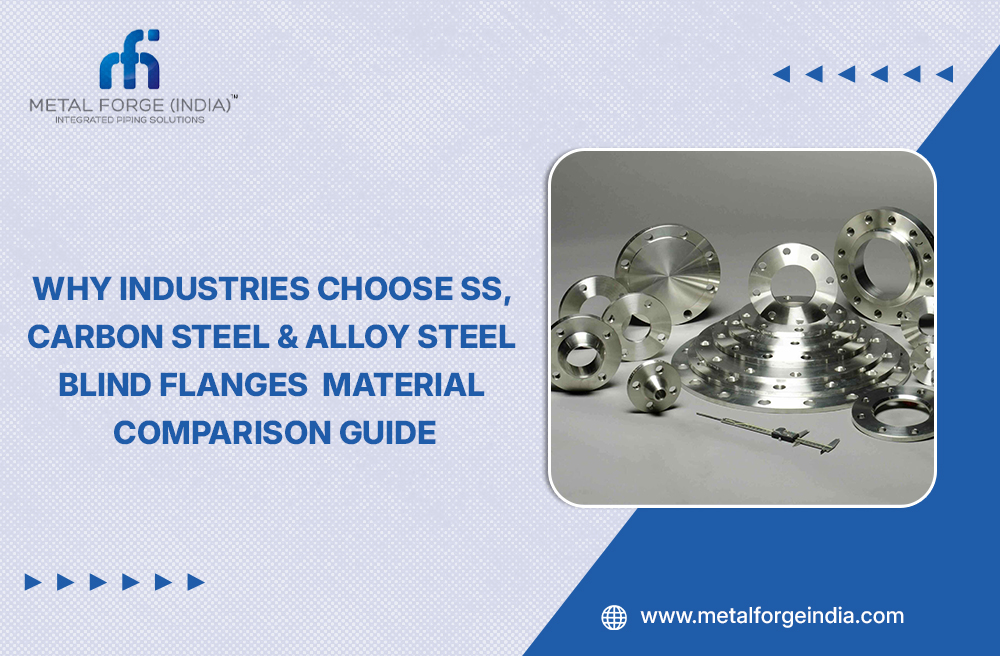
In the piping system Blind flanges are major components that play a major role. Usually, they are used mainly for closing the ends of the pipes, vessels, or valves. Hence, they function mainly as a reliable seal to pre used for a blind flange is crucial for its performance, durability, and cost-effectiveness.
Now, it is in between three common materials, stainless steel (SS), carbon steel, and alloy steel that offer distinct advantages depending on the requirements of the system. Hence, we at Metal forge India, a leading Steel Blind Flanges manufacturer in India offer you this guide that helps you understand in detail the unique properties and applications of each material to help industries choose the best industrial piping flange materials for your needs.
1. Stainless Steel Blind Flanges Benefits and Properties
Stainless steel (SS) is known for its corrosion resistance and durability, making it one of the most popular materials for blind flanges. Stainless steel alloys typically contain chromium, which forms a passive oxide layer on the surface, providing a protective barrier against rust and corrosion. This makes SS blind flanges ideal for use in industries where high corrosion resistance in flanges is required, such as in chemical processing, food and beverage, pharmaceutical, and marine applications.
Benefits of Stainless Steel Blind Flanges:
- Corrosion Resistance: The standout feature of stainless steel is its resistance to corrosion. SS blind flanges can withstand harsh environments, including exposure to water, steam, and chemicals, without deteriorating.
- High Strength and Durability: Stainless steel has excellent tensile strength, making it ideal for high-pressure piping flanges. It can endure significant stress and pressure without compromising structural integrity.
- Temperature Resistance: Stainless steel can handle extreme temperatures, both high and low. This makes it suitable for applications in industries like petrochemical, where hot and cold fluids flow through pipelines.
- Longevity: Due to its corrosion resistance, SS blind flanges have a long service life, reducing the need for frequent replacements and lowering overall maintenance costs.
In short, SS blind flanges are perfect for industries requiring a balance of strength, durability, and resistance to corrosion.
2. Carbon Steel Blind Flanges Properties and Cost-Effectiveness
Carbon steel is another commonly used material for blind flanges. Composed primarily of iron and carbon, carbon steel flanges are known for their strength and affordability. They are widely used in industries that require strong, cost-effective piping solutions but do not face the same extreme corrosion risks as those requiring stainless steel.
Properties of Carbon Steel Blind Flanges:
- Strength and Toughness: Carbon steel is a highly durable material that can withstand considerable stress, making it suitable for high-pressure applications. The more carbon content in the steel, the harder and stronger the flange will be.
- Cost-Effective: One of the primary reasons industries choose carbon steel blind flanges is cost. Carbon steel is less expensive than stainless steel or alloy steel, making it a more budget-friendly option for industries where the flange material is not exposed to harsh environmental conditions.
- Weldability: Carbon steel blind flanges are easy to weld, making them an excellent choice for piping systems that require fabrication and customization.
- Moderate Corrosion Resistance: While carbon steel is more susceptible to corrosion than stainless steel, it performs well in less aggressive environments and can be treated with coatings or galvanization to improve its corrosion resistance.
Carbon steel blind flanges are ideal for general industrial use in low to moderate-pressure systems where cost-effectiveness is a priority, and corrosion resistance is not the primary concern.
3. Alloy Steel Blind Flanges Applications and Advantages
Alloy steel flanges are made by combining carbon steel with other elements like chromium, molybdenum, vanadium, and nickel. These additions give alloy steel unique properties, including improved strength, toughness, and resistance to wear and corrosion. Alloy steel blind flanges are commonly used in industries where high performance, resistance to extreme conditions, and strength are essential.
Applications of Alloy Steel Blind Flanges:
- High-Pressure Systems: Alloy steel blind flanges are highly suitable for high-pressure applications due to their superior strength and ability to withstand elevated stress and heat.
- Heat Resistance: The inclusion of elements like chromium and molybdenum improves the high-temperature performance of alloy steel, making it ideal for industries like power generation and petrochemical, where the pipes may carry hot gases or liquids.
- Corrosion Resistance: While alloy steel may not match the corrosion resistance of stainless steel, certain alloys can offer enhanced resistance to corrosion and oxidation, particularly in high-temperature or chemically reactive environments.
- Durability in Extreme Environments: The combination of strength, heat resistance, and wear resistance makes alloy steel blind flanges a good choice for challenging conditions, such as in the aerospace or heavy industrial sectors.
Alloy steel blind flanges are often used in industries where performance and material durability are more important than cost, and where conditions may be too severe for carbon steel or standard stainless steel.
4. Blind Flange Material Comparison: Choosing the Best Option
Choosing the best material for blind flanges requires understanding the specific needs of the piping system. Below is a quick comparison of the key factors to consider when selecting between stainless steel, carbon steel, and alloy steel:
| Material | Corrosion Resistance | Strength | Temperature Resistance | Cost | Best Use Case |
| Stainless Steel | Excellent | High | High | Expensive | Chemical processing, food and beverage, marine, high-pressure systems |
| Carbon Steel | Moderate | High | Moderate | Low | General industrial applications, lower pressure systems |
| Alloy Steel | Good (varies by alloy) | Very High | Very High | High | High-pressure, high-temperature systems, petrochemical, power generation |
Finally, you need to understand that the choice of material for blind flanges depends on the specific requirements of your piping system. So, when it comes to corrosion resistance Stainless steel is the material that proves to be the best option especially for chemical or marine environments that are Carbon Steel is a cost-effective option wherein corrosion is not a big issue. Moreover, alloy steel provides exceptional strength and heat resistance for high-pressure and high-temperature systems.
Hence when you are choosing the best material among Stainless Steel, Carbon Steel, and Alloy Steel for flanges, we at Metal Forge India, a top Steel Blind Flanges supplier in India recommend that you need to take into consideration a few factors. They include resistance, pressure and temperature requirements, and budget constraints. Contact us for more information.