
In the current industrial pipe systems 3-dimensional pipe bends are playing an important function in ensuring a smooth fluid flow as well as reducing pressure loss and optimizing space within complex pipeline layouts. Industries like oil and gas power plants, petrochemicals refineries, offshore facilities and chemical processing plants depend heavily on well-installed pipe bends to maintain long-term effectiveness.
A successful installation requires precise fitting, correct alignment, controlled welding methods as well as a successful post-weld treatment to ensure compliance to ASME B31 standards for piping. Selecting a reliable 3D bend manufacturer and a seasoned manufacturer of pipe bends in India are equally crucial to ensure high-performance pipe systems.
This guide will explain the entire procedure for three-dimensional pipe bends in India with the most effective methods for alignment, welding inspection, and post-weld treatment for industrial pipe applications.
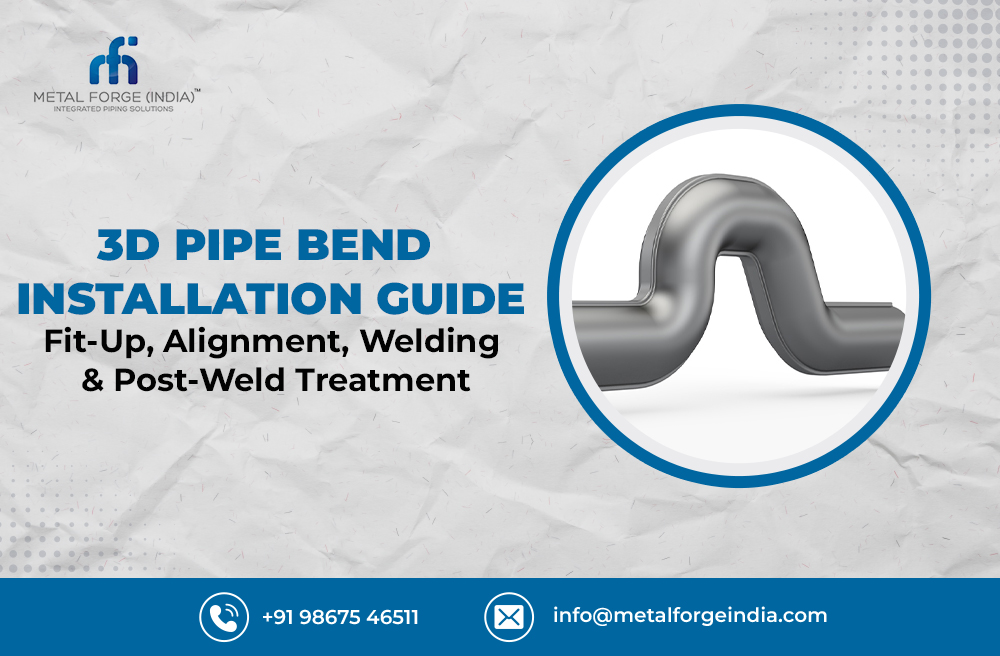
What is a 3D Pipe Bend?
A 3D pipe bend refers to a component of bending a pipe in which the centerline radius is three times the pipe’s nominal diameter. The bends are made to allow for smoother directional changes in piping systems as compared with short radius elbows.
For instance:
R=3DR = 3DR=3D
Where:
- R = Bend Radius
- D = Pipe Diameter
The wider radius can help reduce turbulent flow, pressure drop and deterioration of the pipe system.
Industries favour high-quality pipe bends exported from India due to the fact that they are produced according to international standards, and offer exceptional durability even under high pressure and high temperature conditions.
Importance of ASME B31 Piping Standards in Pipe Bend Installation
The ASME B31 standards for piping offer comprehensive instructions for designing fabrication, inspection, testing and installation of industrial piping systems.
Benefits of observing ASME standards are:
- Improved security of operations
- Lower risk of leakage
- Proper stress distribution
- Better welding strength and integrity
- Increased resistance to corrosion
- The compliance with international industrial regulations
When it comes to the installation of 3D pipe bends in India the conformity in accordance with ASME B31 standards ensures reliability in crucial industrial applications such as oil refineries LNG terminals, as well as thermal power stations.
Step 1: Inspection Before Installation
Before installation can begin the pipe bend must undergo a thorough visual and dimensional examination.
Key Inspection Checks
- Verify the bend radius and dimensions
- Make sure the wall thickness is uniform
- Examine for cracks or surface imperfections
- Check the quality of the material and the heat number
- Ensure end bevel preparation
- Validate certification of compliance
The leading manufacturers of bends for pipes India companies offer mill test certificates and high-quality documentation to assure the product’s reliability.
Step 2: Proper Fit-Up Procedure
Fit-up is among the most crucial steps during the installation of pipes. Incorrect fitting can result in the weld to fail as well as stress concentration and alignment issues.
Best Practices for Pipe Bend Fit-Up
1. Clean Pipe Ends
Clean rust, oil, paint, dirt and moisture from pipe’s end prior to alignment.
2. Check Root Gap
Maintain a consistent root gap in accordance with approved welding methods.
3. Verify Pipe Ovality
Ovality too large can affect the quality of welds and the accuracy of alignment.
4. Use Proper Clamping Tools
Pipe aligning clamps and fixtures aid in helping keep the pipe aligned when welding with tacks.
5. Confirm Centerline Alignment
Unskillful alignment could cause the possibility of stress points and turbulence in the pipe system.
Professional installers who handle 3D pipe bend installations in India utilize laser alignment tools as well as precision gauges to ensure a perfect fit.
Step 3: Pipe Bend Alignment Techniques
Achieving a precise alignment is crucial to ensure that there is no stress on the system operation.
Common Alignment Methods
Manual Alignment
It is used for pipes with smaller diameters with basic design.
Laser Alignment
High precision is required in critical piping systems for process.
Hydraulic Alignment Systems
Ideal for large-diameter and heavy-wall pipe bends.
Alignment Tolerances
In accordance with ASME B31 standard for piping the alignment tolerances have to be kept within acceptable limits to avoid:
- Cracking in the Weld
- Pipe distortion
- Vibration problems
- Limitations on flow
- The stress of thermal expansion
Trustworthy 3D bend firms often offer technical support for installation and advice for the most critical projects.
Step 4: Welding Process for 3D Pipe Bends
Welding is the most important phase of welding pipe bends. The correct welding will ensure strength and integrity as well as leak-proof performance.
Common Welding Methods
GTAW (TIG Welding)
Preferential for root passages and applications using stainless steel.
SMAW (Stick Welding)
The most popular choice for carbon steel pipes.
GMAW (MIG Welding)
Suitable for faster industrial fabrication processes.
SAW (Submerged Arc Welding)
Pipes are used for industrial heavy wall applications.
Welding Preparation Steps
- Ensure proper bevel angle
- Preheat if required
- Verify electrode compatibility
- Maintain welding parameters
- Use qualified welders
- Use the approved WPS (Welding procedure Specification)
Manufacturers who produce pipe bends that are exported quality India guarantee weld compatibility in accordance with the international standard for industry.
Importance of Tack Welding
Tack welding temporarily holds the components in place prior to the final welding.
Benefits of Proper Tack Welding
- Prevents pipe movement
- Maintains the accuracy of alignment
- Reduces the distortion caused by shrinkage of welds
- Enhances the quality of the final weld
Incorrect tack welding could cause joint alignment issues and failure of the weld during tests of pressure.
Step 5: Post-Weld Heat Treatment (PWHT)
Post-weld treatments are often needed for high-pressure and high temperature pipes.
Purpose of PWHT
- Relieves residual stress
- Increases the toughness
- Enhances ductility and strength of the weld
- Reduces hardness
- Reduces risk of cracking
Industries that handle critical fluids typically have to use PWHT as per ASME B31 standards for piping.
Common PWHT Methods
- Furnace Heat Treatment
It is used for shop fabrication.
- Local Heat Treatment
It is applied directly to field welding joints on site during installation.
Step 6: Non-Destructive Testing (NDT)
After post-welding and welding, Inspecting procedures ensure the integrity of the welding.
Common NDT Methods
- Radiographic Testing (RT)
The test detects any internal defects in the welding.
- Ultrasonic Testing (UT)
It is used for measuring thickness and the detection of cracks inside.
- Magnetic Particle Testing (MPT)
Finds surface cracks in ferromagnetic materials.
Dye Penetrant Testing (DPT)
Finds surface discontinuities in the piping made of stainless steel or alloy.
The majority pipe bends that are exported in good quality. India manufacturers conduct NDT tests to verify that they are in compliance with international standards.
Step 7: Hydrostatic Testing
Hydro testing confirms the strength of the piping system that is installed.
Hydro Test Procedure
- Water is needed to fill the system.
- Clean out air trapped
- Gradually increase pressure. Gradually increase
- Maintain specified holding time
- Examine for leaks
Hydrostatic testing makes sure that the bent installed be able to withstand pressures that are typical of operating.
Common Challenges During 3D Pipe Bend Installation
- Alignment Errors
A misaligned alignment can cause the possibility of flow disturbances and vibrations.
- Weld Distortion
Incorrect heat input could alter the bend of the pipe.
- Residual Stress
Inability to conduct PWHT can reduce the lifespan of the pipe.
- Material Mismatch
Filler materials that are not compatible could weaken welding joints.
Selecting a reputable pipe bender manufacturer India can help reduce the risk of installation by providing better manufacturing quality and technical assistance.
Benefits of Pipe Bends that are Export Quality from India
India is now a major manufacturing center for pipe bends in the industrial sector due to the advanced facilities for production as well as international standards for quality.
Benefits of Indian Pipe Bend Manufacturers
- Competitive pricing
- Top-quality raw materials
- Technology for advanced bending
- ASME-compliant production
- Global export capabilities
- Custom-designed manufacturing options
A reputable 3D pipe bend manufacturer in India can offer products that are designed to meet the needs of demanding industries around the globe.
Correct placement of pipe bends 3D is crucial to ensure long-term piping efficiency, security and reliability. From alignment and fitting to post-weld treatment and welding each stage should follow strict quality control guidelines along with ASME B31 pipe standards.
Industries that invest into 3D pipe bends from India gain access to cutting-edge manufacturing techniques, affordable solutions, as well as international quality standards. By partnering with a reliable pipe bend maker India provides the ability to high-quality pipe bends for export from India specifically designed for high pressure as well as industrial high temperatures.
Metal forge India continues to deliver top-quality industrial pipe bends that conform to international standards for engineering and are used to support crucial infrastructure projects around the world.
Premium Quality at an affordable 3D Pipe Bend Installation Price in India then you need to ‘Get in Touch’ with us at Metal forge India
FAQ
1. What is 3D pipe bend?
An 3D pipe bend can be described as a pipe component that has a bend radius of up 3 times or more than the diameter of the pipe and is designed to ensure better fluid flow and reduce pressure loss.
2. What is the significance of ASME B31 piping standards important?
ASME B31 pipe standards provide safety in the fabrication, design welding, testing and installation of industrial piping systems.
3. What is post-weld heating treatment? the pipe bend installation?
The post-weld treatment (PWHT) reduces stress on the residual; it also improves the weld’s toughness and improves the long-term performance of piping.
4. Why should you choose to export high-quality pipe bends in India?
Export quality pipe bends India offer international-standard manufacturing, superior material quality, and cost-effective industrial solutions.
5. How do I choose the most reliable 3D pipe bend?
Choose a dependable 3D pipe bend with ASME-compliant manufacturing advanced testing facilities, top quality certifications, and years of industry knowledge