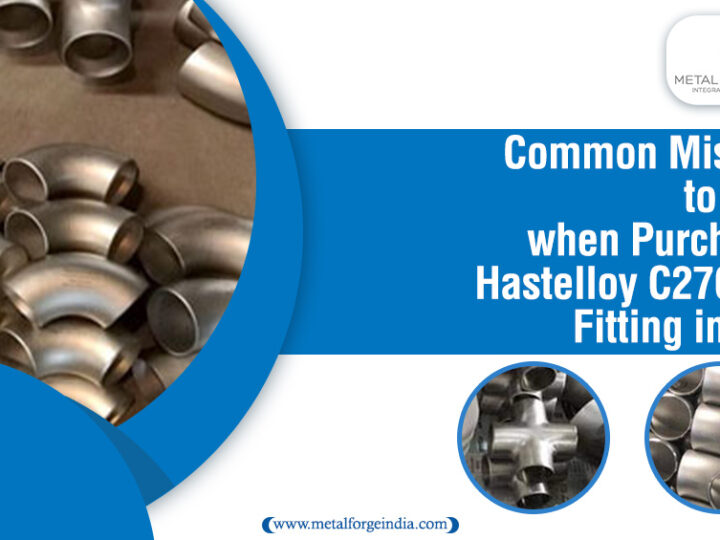

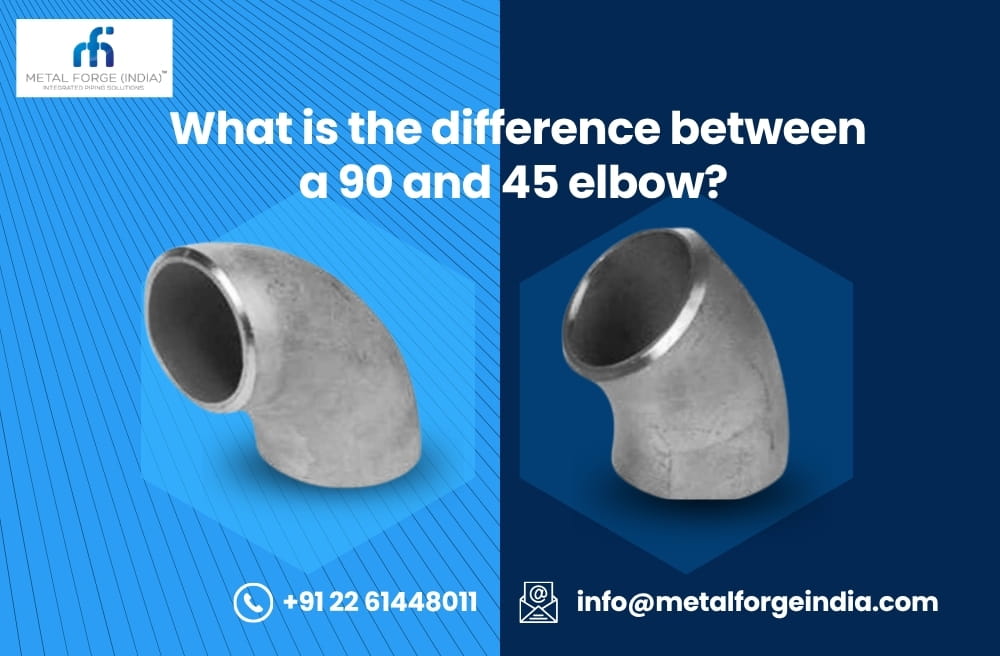
In industrial pipelines elbows are an essential part which are used to alter the direction of flow. For instance, in gas and oil pipelines, chemical facilities, power plants as well as water treatment plants, elbows can help in the creation of efficient and effective pipeline layouts. One of the two widely employed fittings include elbows with angles of 90 degree elbow and the 45-degree elbow. Knowing the distinction in these types of fittings can be crucial for contractors, engineers, and procurement experts in the design of pipelines.
In the blog in this article we’ll look at the distinction between a 90 degree or 45 degree elbow and their uses, as well as how to pick the appropriate fitting from a reliable 90 degree elbow manufacturer, or 45 degree elbow exporter such as Metal forge India.
What Is a Pipe Elbow?
Pipe elbows are fitting that allows you to change the direction of flow within a piping system. It is typically installed within two pieces of tubing or pipe to allow for a change of direction. Pipe elbows can be made at various angles, however the most popular ones are 90 degree and 45degree elbows..
These are made of a variety of materials like carbon steel, stainless steel, alloy steel and duplex steel for various industrial requirements.
What Is a 90degree Elbow?
An 90 degree bend alters directions of pipelines 90 ° and creates an angle turn within the pipeline system. It is among the most commonly employed fittings used in industrial pipelines.
Key Features of a 90deg Elbow
- It creates sharp Right-angle turning
- Available in Long radius (LR) and short radius (SR) designs
- Usually, it is employed commonly in the layout of piping that is tight
- Facilitates the flow of fluids
Industries frequently have a reliable 90-degree elbow producer to guarantee top-quality fittings that are in line with international standards, such as ASTM, ASME, and ANSI.
Applications of 90deg Elbows
90-degree elbows are commonly employed in:
- Pipelines for oil and gas
- Chemical processing plants
- Power generation plants
- Systems for water supply
- HVAC systems
- Pipelines and shipbuilding
Because they make sharp turns they are perfect for installations in which there is a limited space.
What Is a 45deg Elbow?
The 45-degree bend alters the direction of flowing to 45 ° and creates a smoother flow direction when compared to 90-degree elbows.
In lieu of executing a sudden turn instead, it lets the fluid flow in a gradual direction.
Key Features of a 45deg Elbow
- It creates a gradual directional change
- Reduces the amount of turbulence that pipelines experience
- Aids in maintaining fluid flow
- Usually, pipelines are used in long systems
Many industries buy this fitting from a trusted 45 degree elbow exporter to ensure conformity with international piping standards as well as the specifications of projects.
Applications of 45deg Elbows
The 45-degree elbow is commonly employed in:
- Pipelines for long distances
- High-flow systems
- Pump discharge lines
- Transmission pipelines for oil and gas
- Pharmaceutical and chemical plants
Since they offer more fluid movement, these reduce friction and pressure loss in the system.
Key Differences Between 90deg and 45deg Elbows
While both fittings alter their direction, they have significant distinctions.
1. Angle of Direction Change
The most important difference is in the direction of the flow.
- 90 degree elbow The elbow changes the direction of 90 degree (right angle)
- 45 degree elbow It changes the direction of 45 degree
This affects the pipeline layout and the design of the system.
2. Flow Resistance
The flow of fluid is different in these types of fittings.
- 90degree elbows cause more turbulence and pressure drop due to their sharp turns.
- 45 degree elbows permit smoother flow, with lower loss of friction.
This is the reason engineers typically employ two elbows with 45 degrees instead of a single 90deg elbow for high-flow pipelines.
3. Space Requirements
Another significant difference is the area for installation.
- 90 degree elbows are perfect for piping systems that are compact and have small space.
- 45degree elbows require longer lengths of pipe to be installed.
Industrial designers select fittings based on space available and the pipeline’s layout.
4. Pressure Drop
Pressure drop is a key element in the efficiency of pipelines.
- 90 degree elbows More pressure drops due to a sharp change in direction
- 45 degree elbows : Lower pressure drop due to the smoother flow transition
For high-flow or high-pressure systems typically, 45deg elbows are the most preferred.
5. Application in Piping Systems
The two fittings have different functions in pipelines used for industrial use.
90 degree elbows can be frequently employed in:
- Pipelines for process
- Plant piping layouts
- Structural pipe systems
45degree elbows can be frequently employed in:
- Long pipelines
- Systems that respond to flow
- Pump discharge lines
Partnering in conjunction with a seasoned 90 degree elbow manufacturer, along with a Exporter of 45 degrees elbows guarantees the correct choice of product for every project.
Materials Used for Pipe Elbows
Pipe elbows are made from diverse materials to meet the needs of the market.
Common materials are:
- Stainless Steel (SS 304, 316, 321)
- Carbon Steel
- Alloy Steel
- Duplex Stainless Steel
- Super Duplex Steel
- Nickel Alloys
Companies such as Metal Forge India manufacture elbows that meet international standards like ASME B16.9, ASTM as well as ANSI standards.
Why Quality Pipe Elbows Matter
The choice of high-quality elbows is crucial for the security and performance of pipe systems.
Incorrect fittings may cause:
- Leakage in pipelines
- Costs of maintenance have increased
- Pressure losses
- System failure
Industries are accustomed to purchasing fittings from a reputable 90 degree bend manufacturer and a worldwide renowned exporter of 45 degree elbows such as Metal forge India is renowned for its precise engineering and strict quality control.
Why Choose Metal Forge India?
Metal Forge India is a prominent exporter and producer of top-quality pipe fittings for industrial applications.
Some of the advantages are:
- Advanced manufacturing facilities
- Conformity to international standards
- A wide range of sizes and materials
- Global export capabilities
- Testing and inspection of strict quality
As a dependable 90 degree elbow manufacturer, and exporter of 45 degree elbows, Metal forge India supplies robust and high-performance piping parts for industrial environments that require high-performance components.
The two 90 degree as well as 45 degree elbows play a crucial role in industrial pipe systems. Although the 90 degree elbow offers a sharp directional shift and works in small areas and tight spaces, the 45 degree elbow provides a smoother flow and a lower drop in pressure.
The best fitting for your needs is dependent on factors like the layout of the pipeline, the fluid’s dynamics, requirements for pressure and space. Working with an experienced 90 degree elbow producer and dependable exporter of 45 degrees elbows such as Metalforge India industries can guarantee safe, reliable long-lasting and durable piping systems.
FAQ
1. What is the major difference between an elbow that is 90deg and the 45deg elbow?
The primary difference is the angle at which direction changes. An 90 degree elbow directs pipeline flow in a right angle in the opposite direction, whereas the 45 degree bend shifts the direction 45 degrees, which allows for more fluid flow.
2. When should 90-degree elbows be employed in the piping system?
The 90 degree elbow is usually employed when a sudden shift in pipeline direction is needed, particularly in systems that are compact and in which space is constrained.
3. Why do engineers make use of two 45deg elbows instead of a single 90deg elbow?
Utilizing 2 90deg bends allows for a smoother direction change, reducing the amount of turbulence and pressure drop within the pipeline.
4. Which industries typically make use of 45-degree elbows?
Industries like gas and oil power generation, chemical processing as well as water treatment often use elbows with 45 degrees to maximize fluid flow.
5. Where do I find a reputable manufacturer of 90 degrees elbows as well as an exporter of 45 degree elbows?
You can purchase high-end pipes from Metal forge India, a reputable 90-degree elbow maker along with a Exporter 45 degrees elbow providing industrial piping solutions around the world.