
In the modern industrial pipes pipe fittings play an essential role in providing seamless flow, pressure control and efficient flow of gases and fluids. Of these fittings, the one with a 180-degree elbow is extensively employed in various industries, including oil and gas and power plants, petrochemicals and food processing, pharmaceuticals as well as chemical production. These fittings are specially designed to alter the flow direction by 180 degrees, while preserving the integrity of the system, and minimising pressure loss.
In industries that need toughness and resistance to corrosion, choosing a reliable stainless steel 180-degree elbow supplier is crucial. The highest-quality elbows that are manufactured in accordance with international standards provide long-lasting service as well as dimensional precision and outstanding performance in the most demanding conditions.
Hence we at Metalforge India a leading stainless steel 180 degree elbow supplier in India. offer you this blog explaining everything you need to know about 180 degree elbow standards.
What is a 180 Degree Elbow?
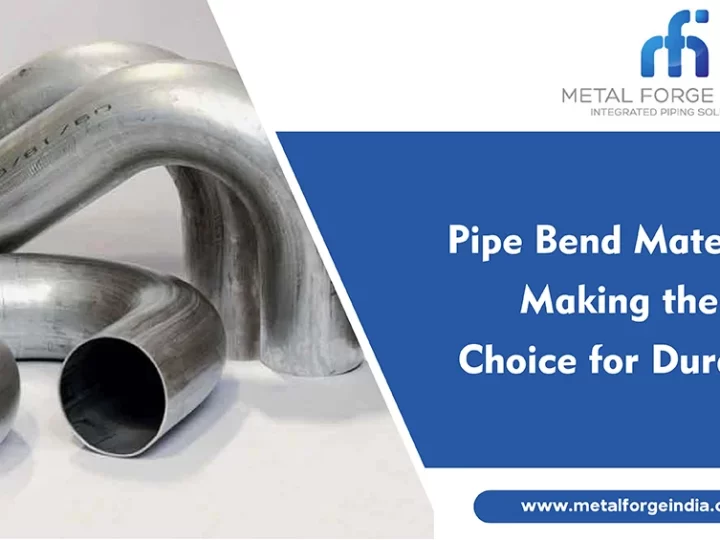
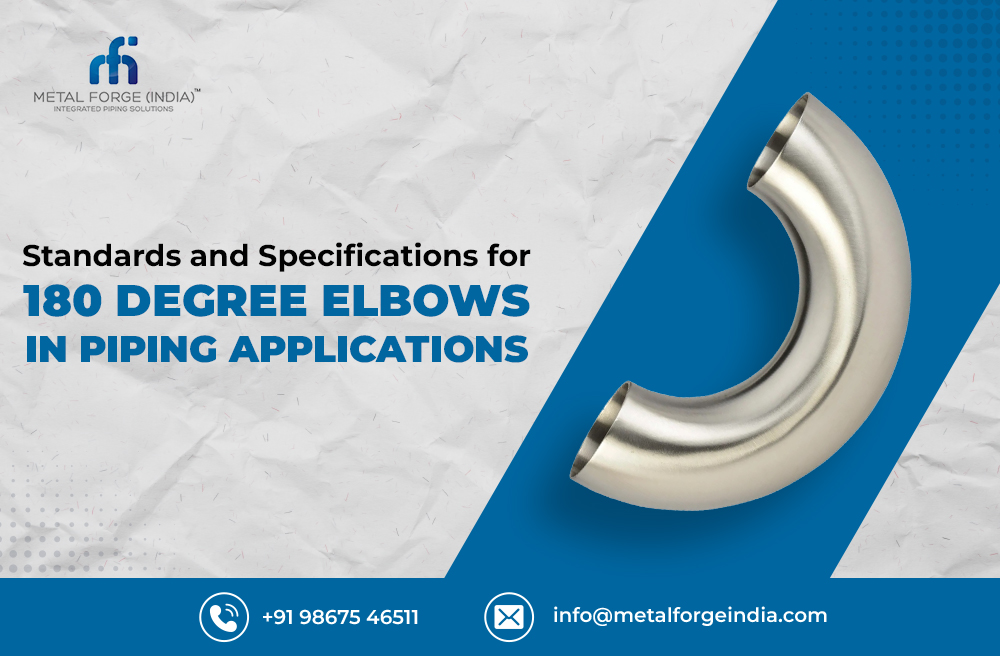
The 180° elbow refers to a pipe fitting that is used to switch the flow direction completely to an opposite direction. It is usually known as an “return elbow” due to the fact that it causes an U-turn within the piping system. They can be found in various materials as well as wall thicknesses, schedules, and connections at the end based on the specific requirements for the application.
Industries favor fittings made by a reputable manufacturer of elbows with a 180-degree angle because poor quality or inadequate dimensions materials can cause the leakage of pressure or even premature system failure.
Importance of Standards in 180 Degree Elbows
Industrial piping systems work in high temperatures, pressures and conditions that are corrosive. Thus, a standardization process is vital to ensure safety, compatibility as well as performance. International standards define:
- Dimensional tolerances
- Material composition
- Ratings of pressure
- Test procedures
- Manufacturing techniques
- Criteria for inspection
Utilizing standard elbows enables seamless integration into pipe systems across industries around the world.
ASME B16.9 Standard for 180 Degree Elbows
A number of widely-accepted standards for fittings with butt welding are an ASME B16.9 specification. A skilled ASME B16.9 elbow supplier makes fittings in accordance with this globally acknowledged standard to ensure quality and dimensional stability.
Its ASME B16.9 standard is a guideline for:
- Fittings for welding with wrought iron that are made in the factory
- Dimensions and tolerances
- Wall thickness compatibility
- Final preparation
- Surface quality
- Ratings for pressure-temperature
The standard is applicable to fittings made of carbon steel, stainless steel, alloy steel and various other materials.
Types Covered Under ASME B16.9
The specification covers various pipe fittings like:
- Long radius elbows
- Short radius elbows
- Tees
- Reducers
- Caps
- Stub ends
- 180 degree return bends
This standard guarantees that fittings of different manufacturers are in a state of interchangeability and compatibility with the standard pipe systems.
Materials Used for 180 Degree Elbows
The efficiency of a 180 degree elbow is contingent on the materials used in production. A reputable 90 degree bend made of stainless steel manufacturer has fittings available in various grades that are suitable for a variety of industrial settings.
Stainless Steel Grades
The most common stainless steel grades are:
- SS 304
- SS 304L
- SS 316
- SS 316L
- SS 321
- SS 904L
The stainless steel elbows are great:
- Resistance to corrosion
- High-temperature durability
- Hygienic properties
- Durability
- Weldability
This makes stainless steel the ideal material for marine, chemical processing pharmaceutical, food-grade, and chemical applications.
Carbon Steel and Alloy Steel
To perform high-temperature and high pressure operations, industries also utilize:
- ASTM A234 WPB
- ASTM A420 WPL6
- ASTM A403 grades of stainless
- Fittings made of alloy steel
Selecting the best material depends on the type of fluid used, its operating temperature, pressure and the environment.
Manufacturing Process of 180 Degree Elbows
A 180 degree elbow manufacturer of elbows 180 degrees uses the most advanced manufacturing processes to ensure top-quality products.
-
Hot Forming Process
The majority of elbows are made by using hot forming methods which involves heating pipes and then bent to the desired shape. This procedure improves the structural integrity and decreases stress concentration.
-
Cold Forming
For specific applications cold-forming is utilized to get more precise dimensions and improve quality of finish on the surface.
Welding and Finishing
After forming, elbows undergo:
- Treatment of heat
- Passivation and pickling
- Polishing the surface
- Dimensional inspection
- Non-destructive tests
These processes guarantee the compliance of global quality standards.
Dimensional Specifications
The dimensions of the 180 degree elbows are determined by the size of the pipe and radius.
-
Long Radius (LR) Elbows
They have a radius of 1.5 times the pipe’s nominal size. They are widely used due to the fact that they decrease turbulence and reduce pressure loss.
-
Short Radius (SR) Elbows
Short radius elbows feature a radius that is the same as the pipe’s nominal size. They are utilized when the space is limited.
A well-known ASME B16.9 elbow supplier offers elbows in both LR as well as SR elbows. They are available in various schedules, including:
- SCH 10
- SCH 20
- SCH 40
- SCH 80
- SCH 160
- XXS
Testing and Inspection Standards
Industrial fittings need to pass strict tests prior to supply. Manufacturers who are reliable follow international standards for inspection to ensure the quality of their products.
Common Tests Include
-
Hydrostatic Testing
Verifies the fitting’s capacity to withstand pressure from within.
-
Ultrasonic Testing
The system detects any flaws, discontinuities or internal imperfections.
-
Radiographic Testing
It ensures quality welds and structural strength.
-
Positive Material Identification (PMI)
Verifies the composition of the material.
-
Dimensional Inspection
Checks for compliance to ASME tolerances and dimensions.
These quality checks can help businesses prevent costly breakdowns and delays.
Applications of 180 Degree Elbows
The 180-degree elbow can be employed across a variety of industries due to their ability to change the flow direction effectively.
-
Oil and Gas Industry
It is used in both pipelines that handle onshore and offshore gas, crude oil and petroleum chemicals.
-
Chemical Processing
Steel elbows made of stainless steel resist corrosion by acidic and aggressive chemicals.
-
Food and Beverage Industry
Fittings made of stainless steel that are hygienic work for plumbing systems that are sanitary.
-
Pharmaceutical Plants
Smooth surfaces on the internal surface reduce the risk of contamination and increase the cleanliness.
-
Power Plants
Steel elbows made of high-temperature alloy can be employed in boiler and steam pipelines.
-
Water Treatment Plants
Long-lasting performance with corrosion-resistant elbows for water-based systems.
Advantages of Stainless Steel 180 Degree Elbows
The choice of products from a reliable 90 degree bend in stainless steel from a vendor has several benefits:
- Excellent corrosion resistance
- Long-lasting operational life
- Lower maintenance costs
- High-pressure handling capability
- Superior mechanical strength
- Smooth flow features
- Superior resistance to temperature
These benefits are what make elbows made of stainless steel the ideal option for industrial environments that are extremely demanding.
Choosing the Right 180 Degree Elbow Manufacturer
The right choice of manufacturer is vital to ensure high-quality products and reliability of projects.
Important Factors to Consider
- In compliance with ASME B16.9 standards.
- Material traceability
- Testing facilities in-house
- Experience in industrial pipework
- Quality manufacturing for export
- There are a variety of sizes and grades
- Timely delivery
A reputable manufacturer of elbows with a 180 degree angle includes all documentation needed, including tests certificate, report of the inspection and materials certifications.
90 degree elbows can be essential components of industrial piping systems in which flow direction reversal is essential. Their durability, performance, and safety are heavily dependent on the compliance of international standards, such as ASME B16.9. Industries all over the world depend on certified fittings in order to keep effective and leak-proof operations.
A partnership with a skilled stainless steel 180-degree elbow provider will give you access to quality fittings made to last for the long term use in industry. For oil and gas or pharmaceuticals, chemical plants as well as power generation, selecting an experienced ASME B16.9 elbow manufacturer will guarantee top quality, precise engineering, and reliable performance.
Premium Quality at an affordable 180 Degree Elbows in India then you need to ‘Get in Touch’ with us at Metalforge India
FAQ
1. What is a 180-degree elbow for? What is it used for in pipe systems?
An elbow with a 180 degree angle is utilized to change the direction of flow in a piping process. It is typically used in power plants, as well as chemical applications.
2. What is the ASME B16.9 norm for elbows?
ASME B16.9 is an internationally recognized standard governing dimensions, tolerances, as well as manufacturing specifications for factory-made wrought welding fittings, including 180-degree elbows.
3. Why are stainless steel elbows with 180 degrees the most sought-after?
Stainless steel elbows provide excellent durability, corrosion resistance as well as high-temperature strength and extended service life. This makes the perfect choice for industrial applications.
4. What is the main difference between long radius and short elbows with 180 degrees?
Long radius elbows have a greater bent radius that minimizes pressure loss, whereas the short radius elbows can be smaller and are suitable for installations with limited space.
5. How do I pick the most suitable 180 degree elbow manufacturer?
Choose a supplier that has ASME-certified production, rigorous quality control, traceability of materials and a wealth of experience in the production of industrial-grade fittings for piping.