

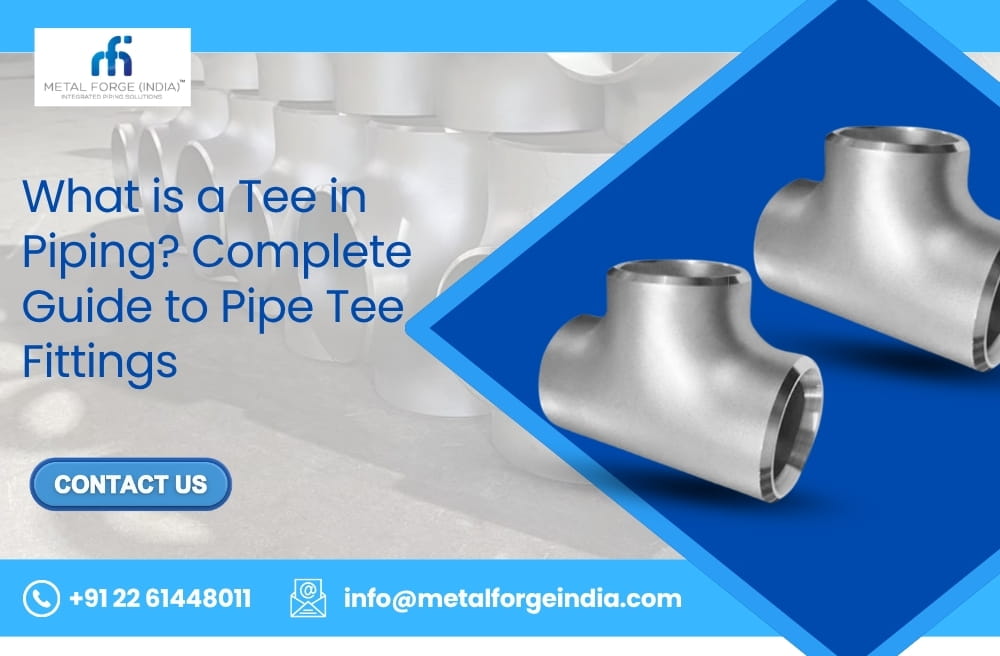
Fittings are important in the industrial piping systems to regulate the direction and flow of fluids. The pipe tee is one of the most commonly employed fittings; it is a fitting that is used to join three pieces of pipe. A tee fitting allows the pipelines to be diverted to various directions and is therefore important in oil and gas, petrochemicals, power generation, water treatment, and chemical processing industries.
When you are designing a piping system or improving on an already installed piping system, it is important to know what a pipe tee is. By choosing a good Tee Pipe Fitting Supplier, you will be sure that your piping system is not only durable and leak-free but it is also efficient.
In this detailed manual by Metal forge India, we shall discuss what a pipe tee is, what are the types and materials of pipe tee, how to use a tee and what is the correct type of tee to use in your project.
What does a Tee in Piping mean?
A pipe tee is a pipe fitting that is in the form of a T. It consists of three openings called inlet and two outlets (or vice versa) where fluid flow can be separated or mixed in a piping system.
The principal pipe is usually straight whereas the branch pipe meets at a right angle thereby forming a right angle flow path. Tee fittings are applied to flow fluids, gases or slurries of a main line to various directions.
Due to their design and purpose, tees form one of the most common types of fittings in intricate piping networks.
An established Tee Pipe Fitting Supplier such as Metal forge India produces tees as per the international standards to make sure they are strong, corrosion resistant and fit with various pipeline systems.
Tee Pipe Fitting types.
The pipe tees come in a variety of designs based on the size of the pipes, flow needs and design of the system.
1.Characteristic (Straight Tee)
An equal tee is one with all the three openings of the same size. It implies that the size of the main pipe and the branch pipe are the same.
Key features:
- Uniform pipe diameter
- Balanced flow distribution
- Large-scale applications in water supply and industrial piping.
Equal tees are perfect when the line requires to divide the flow to two directions without reducing the size of the pipe.
2. Reducing Tee
A reducing tee joins pipes of various diameters. The branch outlet is smaller compared to the main pipe.
Advantages:
- Enables interconnectivity of pipe sizes.
- Force flow rate.
- Saves installation space
Reducing tees are also typically applied in process plants and HVAC systems where the pipeline size varies across the system.
3. Barred Tee
A barred tee will have bars placed within the branch outlet so that the cleaning tools (pipeline pigs) cannot get into the branch line.
Applications include:
- Oil and gas pipelines.
- Pigging systems
- Long-distance pipelines
The fittings are used to safeguard the pipeline infrastructure in the event of cleaning exercises.
4. Lateral Tee
A lateral tee is not like a normal tee in that the branch outlet is located at 45 degrees rather than 90 degrees.
Benefits:
- Reduced turbulence
- Improved flow efficiency
- Lower pressure drop
The lateral tees are popular with drainage systems and fluid transport lines.
The Tee Pipe Fittings are made of the following materials.
Pipe tees can be fabricated in a great variety of materials according to pressure, temperature and corrosion needs.
1. Carbon Steel
The carbon steel tees are very popular due to their strength and low cost.
Applications:
- Oil and gas pipelines.
- Industrial piping systems
- Power plants
2. Stainless Steel
Stainless steel tees are very resistant to corrosion and also very durable.
Common grades include:
- SS 304
- SS 316
- SS 321
The tees are applicable in chemical, pharmaceutical and food processing industries.
3. Alloy Steel
Alloy steel tees are made to be high-pressure and high-temperature.
They are usually applied in petrochemical plants, boilers and refineries.
4. Nickel Alloy
Nickel alloys are high-temperature and have a greater resistance to corrosion.
Industries involving the use of nickel alloy tees are:
- Marine engineering
- Chemical processing
- Offshore platforms
The Tee Pipe Fitting Supplier should be reliable to ensure that the selection of material is done according to industry standards and requirements.
Tee Pipe Production.
Pipe tees are produced in a special process to provide strength and dimensional integrity.
1. Hot Forming
Under this technique, the steel pipes are heated and pressed into tee-shaped under hydraulic presses.
Advantages:
- Strong structure
- Smooth internal surface
- Appropriate with large diameters.
2. Hydroforming
Hydroforming involves the use of high pressure fluid to form the pipe in to a tee.
Benefits:
- Precise dimensions
- Reduced material waste
- High production efficiency
3. Welding Fabrication
In this technique a series of pipe lengths are sliced and welded together to create a tee.
This method is typically applied to large or bespoke fittings.
Tee Pipe Fittings Applications:
Pipe tees are very necessary in most industries as they are involved in the distribution of fluids.
1. oil and gas industry
Tees are commonly applied in exploration, refining and transportation pipelines to separate flow between process units.
2. Chemical Processing Plants
Tees manufactured under corrosion-resistant materials are needed in chemical plants to transport aggressive chemicals safely.
3. Power Generation
Pipe tees are used in steam lines, cooling water systems and fuels pipelines by power plants.
4. Water Treatment Systems
The municipal and industrial water systems use tees in supplying water networks and in water-filtering units.
5. HVAC Systems
Pipe tees are used in heating and cooling systems to spread air, water or refrigerants to various parts of the building.
Advantages of Using Tee Pipe Fittings.
High quality pipe tees have a variety of benefits:
1. Efficient Flow Distribution
Tees enable flow of fluid to be divided into various directions.
2. Versatile Design
They are applicable in different piping arrangements.
3. Easy Installation
Pipe tees make the design and installation of pipelines easier.
4. Cost-Effective
They minimize the use of more connectors or fittings.
5. Durable Performance
Tees of good quality have a long lifespan even in hostile conditions.
The collaboration of an experienced Tee Pipe Fitting Supplier such as Metal forge India guarantees that you will be supplied with fittings of international quality.
Selection of the appropriate Pipe Tee.
Selecting the right tee fitting depends on several factors:
- Pipe Size
Ensure compatibility between the main pipe and branch pipe. - Material Selection
Choose materials based on corrosion resistance and operating conditions. - Pressure Rating
The tee must withstand the system’s operating pressure. - Temperature Conditions
High-temperature environments require specialized alloys. - Industry Standards
Look for compliance with standards such as ASTM, ASME, and ANSI.
A reputable Tee Pipe Fitting Supplier can help you select the right specification for your project.
Why Choose Metal Forge India for Pipe Tee Fittings?
Metal forge India is a trusted manufacturer and Tee Pipe Fitting Supplier offering high-quality piping components for global industries.
Key advantages include:
- Precision-engineered pipe fittings
- Wide range of materials and sizes
- Compliance with international standards
- Strong global export network
- Reliable quality control processes
Their products are used across industries such as oil & gas, petrochemicals, power plants, and marine engineering.
Pipe tees are one of the most important components in industrial piping systems. Their ability to connect three pipelines makes them essential for distributing and controlling fluid flow. Whether used in oil pipelines, chemical plants, or water systems, pipe tees ensure efficient and reliable operations.
Understanding the different types of tees, materials, and applications can help engineers and project managers design better piping systems. Partnering with a trusted Tee Pipe Fitting Supplier like Metal forge India guarantees high-quality fittings that meet industry standards and deliver long-term performance.
FAQ
1. What is a tee pipe fitting used for?
A tee pipe fitting is used to connect three sections of pipe and allow fluid flow to branch off in different directions within a piping system.
2. What are the main types of pipe tee fittings?
The main types include equal tee, reducing tee, barred tee, and lateral tee. Each type serves different piping and flow requirements.
3. What materials are pipe tee fittings made from?
Pipe tees are commonly manufactured from carbon steel, stainless steel, alloy steel, and nickel alloys depending on pressure, temperature, and corrosion requirements.
4. How do I choose the right tee pipe fitting for my system?
You should consider pipe size, material compatibility, pressure rating, temperature conditions, and compliance with industry standards when selecting a tee fitting.
5. Why should I buy from a reliable Tee Pipe Fitting Supplier?
A trusted Tee Pipe Fitting Supplier ensures high-quality materials, precise manufacturing, and compliance with global standards, ensuring durability and safety in piping systems.