Pipe spools · Fabrication · 2026
Metal Forge India is a manufacturer and exporter of flanges, forged fittings, buttweld fittings, pipe spools, olets and fasteners since 1979. Factory: Mehsana, Gujarat. HQ: Mumbai. This page explains what a spool is, how fabrication is sequenced, which drawings and tests matter, and how to RFQ an export lot without mixing it up with loose fittings.
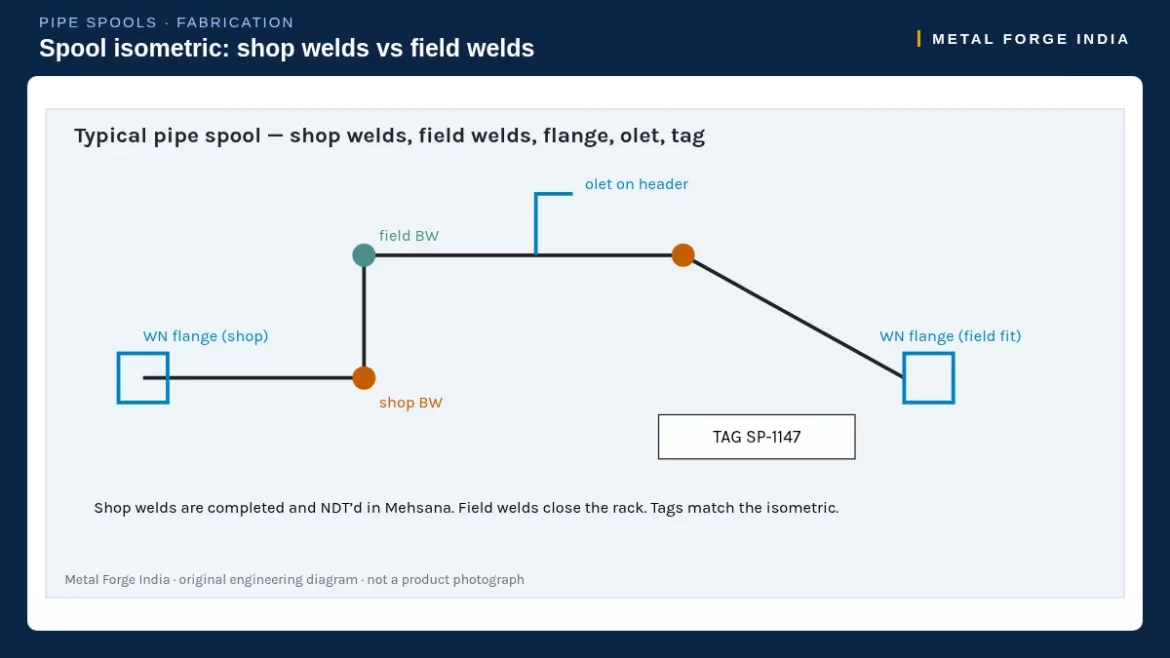
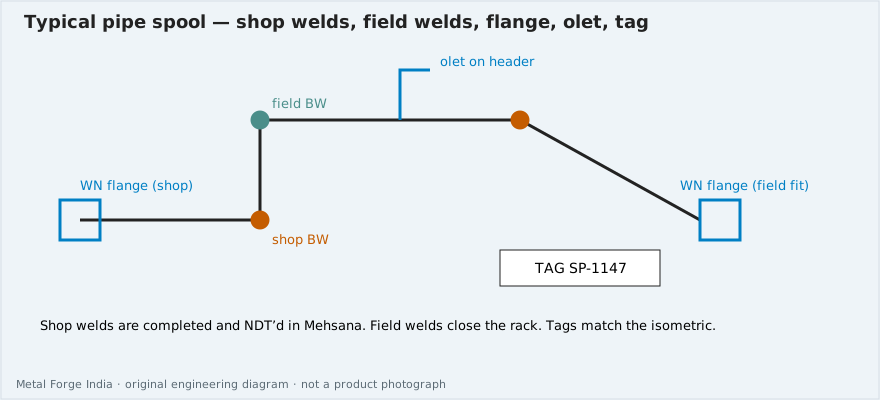
A pipe spool is a tagged assembly built to an isometric: pipe, fittings, flanges and olets cut, welded, then NDT and hydro before packing. Shop welds close in Mehsana. Field welds close the rack. Mill pipe is only a length. Send frozen drawings.
Metal Forge India has manufactured flanges, fittings and pipe spools since 1979. Head office: Mumbai. Factory: Mehsana, Gujarat.
Download spool fabrication spec chart (PDF)
What is a pipe spool in piping?
On a construction isometric, a line is broken into lift-sized pieces. Each piece that can be fully welded in the shop — between two field welds or flanged joints — is a spool. It gets a unique number (often the isometric number plus a suffix), a material take-off, and a tag that survives blasting and paint.
Pipe spooling is the work of turning those drawings into steel: cutting, bevelling, fitting, welding, NDT, testing, coating and packing. It is not a separate product family from pipe spools as a commercial item; this guide is the engineering explanation of that product page.
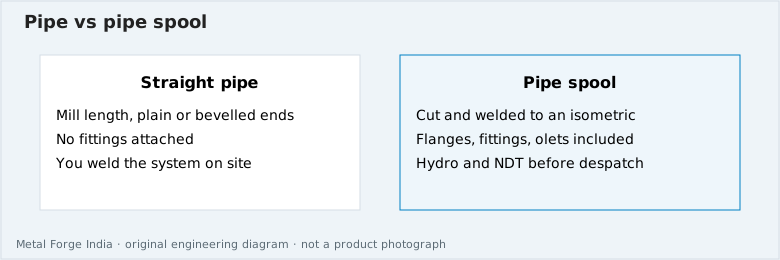
Pipe vs pipe spool
| Pipe | Pipe spool | |
|---|---|---|
| What you buy | Straight length, NPS × SCH × grade | Tagged assembly to an isometric |
| Ends | Plain, bevel, or mill finish | Bevels, flanges, or caps as drawn |
| Welds | None (or the mill seam on welded pipe) | Shop welds already made and NDT’d |
| Documents | MTC for the heat | MTC + WPS + NDT + hydro + packing list |
| Site work | Cut, fit, weld everything | Lift, align, make field joints |
A longer comparison lives at pipe vs pipe spool. This table is the buyer version.
How pipe spool fabrication is done
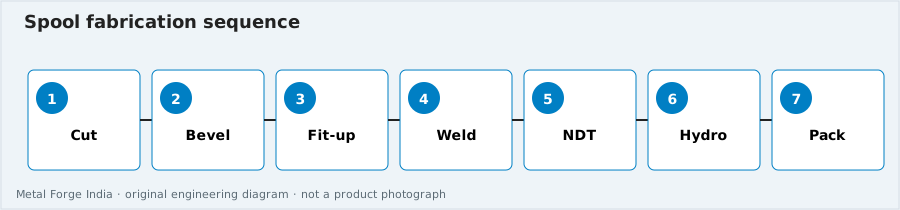
The sequence below is the shop logic used across oil & gas, petrochemical and power work. Hold-points (who signs, which NDT, whether hydro is by spool or by test pack) are defined in the client ITP — we do not invent a default hydro pressure on this page.
- Drawing and BOM review. Check NPS, schedule, grade, flange class, gasket facing, olet size-on-size vs reducing, and which joints are shop welds vs field welds. Missing FW flags are the usual delay.
- Cut and bevel. Pipe cut to the isometric lengths; weld bevels to the WPS (typically 37.5° ± for buttweld, as specified). Branch holes for olets are cut to the MSS SP-97 / fitting template.
- Fit-up. Flanges squared to the hub; elbows and tees aligned to the coordinates; root gap and high-low within the WPS. Tack welds only with qualified consumables.
- Weld. SMAW / GTAW / combination per the qualified WPS. Stainless and nickel alloys get purge where the WPS requires it. Heat input on duplex is controlled — it is not “weld like 316.”
- NDT. Visual plus RT or UT / PT / MT to the class. Shop welds should be accepted before coating. We do not claim a default NDT percentage here; it is an ITP number.
- Hydrotest (when specified). Water quality, pressure, hold time and gauge range follow the test pack, not a catalogue. Some owners hydro at site only; some require shop hydro of each spool.
- Coat, tag, pack. Paint or pickling/passivation as specified. Ends capped. Export packing for sea freight from Nhava Sheva or Mundra. Tag must still be readable on the quay.
The older procedure article pipe spool fabrication procedure stays as a process companion. Oil & gas project context: pipe spool fabrication for oil & gas.
Isometric drawings explained
An isometric is a single-line 3D view of one line number. For spooling, the fields that actually change the shop are:
- Spool breaks — where a shop weld ends and a field weld or flange face begins
- BOM — pipe grade and SCH; fitting standards (B16.9, B16.11, MSS SP-97); flange standard and class; fastener set if it ships with the spool
- Coordinates / centre-to-centre — these become cut lengths after fitting take-off
- Support marks — shoes and trunnions that must be shop-welded
- NDE symbols — which welds are 100% RT vs spot vs PT
If you do not have isometrics yet, an RFQ can still start from a P&ID plus a line list — but the shop cannot cut until the isometric (or a dimensioned sketch with weld breaks) exists. Send the PDF or DWG with the form; do not paste coordinates into the message field only.
Materials and components inside a spool
A spool is only as correct as its pieces. Typical bill:
- Pipe — seamless or welded, to the line class (for example A312 stainless, A106 carbon, nickel alloys)
- Buttweld fittings to ASME B16.9 — elbows, tees, reducers, caps
- Flanges to B16.5 / B16.47 — weld neck on high-pressure lines, slip-on or socket weld where the class allows
- Olets (Weldolet, Sockolet, Threadolet) where a branch is cut-in rather than a reducing tee
- Bends (3D / 5D / 10D) when the isometric uses a bend instead of elbows
- Fasteners and gaskets — only if the packing list says they ship with the spool
We do not list mill stock or a default size envelope on this page. Size, class and grade belong on the RFQ.
QA documents for export spools
| Document | What it proves | When it is included |
|---|---|---|
| EN 10204 3.1 MTC | Heat chemistry + mechanicals for pipe/fittings/flanges | Normal with the lot |
| EN 10204 3.2 | Same tests witnessed by a purchaser-named body | Only if the PO names TPI / 3.2 |
| WPS / PQR + welder ID | The shop weld was qualified | Always for coded work |
| NDT report | Shop welds accepted to the ITP | Per the specified % |
| Hydro chart | Test pack held the pressure | When shop hydro is required |
| COO + packing list | Export clearance and piece count | Every export shipment |
is the factory quality system. and apply when the client’s equipment category requires them — they are not automatically attached to every spool.
Export packing
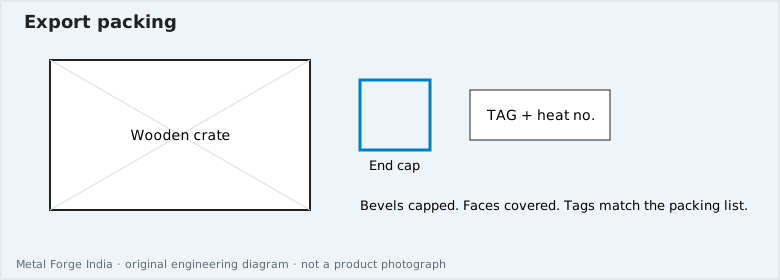
Spools leave Mehsana for west-coast load ports (Nhava Sheva / Mundra are the usual Indian gateways). Ends are capped; machined flange faces protected; wooden cases or pallets used when the geometry needs it, with heat-treated wood where the destination requires ISPM-15. We do not publish transit days as a delivery guarantee. Typical ocean routing is measured in weeks, not overnight air, unless the client books otherwise.
Types of spools you will see on an isometric
Straight spools are pipe plus two flanges or two bevels. They look simple and still need square flange faces and the right facing. Offset spools combine elbows so the centreline moves in two planes — fit-up time is in the coordinates, not in the BOM count. Header spools carry olets or reducing tees; the branch schedule and reinforcement (pad vs olet vs tee) must match the class. Rack modules group several line numbers on a steel frame; they are a logistics choice, not a different material spec.
None of these types is a reason to create a new URL. They are how an isometric is broken. If the client sends a point cloud or a 3D model instead of isometrics, we still need weld breaks before we cut.
Shop weld vs field weld — why the break matters
Every extra field weld is scaffolding, weather, NDT access and often a later hydro of a larger pack. Every extra shop weld is crane capacity and the risk of a spool that will not thread through a doorway. The isometric’s FW/SW marks are an engineering decision. We will not move a field weld into the shop just to make a prettier assembly if the lift or the coating sequence forbids it. Conversely, we will not leave a weld for site because it is “easier” if the ITP says shop RT.
Coatings change the break: some owners want shop-coated spools with field-weld cut-backs; some paint everything at site. State coating in the RFQ. Stainless may be pickled/passivated instead of painted. Mixed-material spools (for example a carbon shoe on a stainless line) need an isolation detail — we will not weld carbon shoes onto stainless without that note.
NDT and hydro without invented percentages
Coded piping uses an NDT percentage from the owner spec (for example ASME B31.3 category M vs normal fluid service). This article will not invent “100% RT on all spools.” If your ITP says 10% RT plus 100% PT on socket welds, that is what we plan. Hydrotest water quality for stainless (chloride limits) is a real constraint; if the test is at site, the shop hydro line on the ITP should be marked NA rather than silently skipped.
Olets on a header are often the NDT headache: a Weldolet fillet/groove is not the same radiograph as a buttweld. Put the olet type on the BOM. Comparison posts on this site — Weldolet vs Sockolet vs Threadolet and Weldolet vs Sweepolet — stay on their ranking URLs.
HowTo: shop sequence (summary)
The numbered list above is the HowTo. It is the same sequence a QA engineer would walk on a floor tour: drawing → cut → fit → weld → NDT → test → coat → pack.
Request a pipe spool RFQ
Attach the isometric or a dimensioned sketch, line class, and quantity of spools. Factory: Mehsana. HQ: Mumbai.
Common mistakes we see on spool enquiries
- Sending a P&ID and asking for a price per metre. Spools are tagged assemblies.
- Omitting flange facing or class so the shop guesses RF 150.
- Mixing A182 F-grades onto buttweld elbows (those elbows are A403 / A234).
- Asking for 100% RT and shop hydro without an ITP — we need the hold-points.
- Forgetting that stainless and carbon cannot share blasting grit or packing cells.
- Using a country blog as the product page. The commercial URL is /pipe-spools/.
Field labour vs shop labour is a project decision. Prefabrication wins when NDT, coating and weather are expensive at site. Loose fittings win when the isometric is still moving every week. We will not tell you that spools are always cheaper.
What a complete spool RFQ looks like
Attach: isometric PDF (or DWG), line list or piping class, material grades, NDT/hydro ITP extract, coating spec, packing constraint, destination port, and whether fasteners/gaskets travel with the spool. Name the quantity as “12 spools on isometric 12-P-101” not “12 metres of pipe.” If some welds are field, mark them. If the lot is nickel alloy, say which product URL you think you are buying (625 vs 400 vs C276) so we do not quote the wrong family.
Glossary
- SW / FW — shop weld / field weld on the isometric.
- BOM — bill of materials; every flange class and olet type should appear here, not only in a CAD note.
- ITP — inspection and test plan; hold-points for NDT, hydro, coating.
- WPS / PQR — welding procedure specification and the supporting procedure qualification record.
- Cut-back — uncoated length left at a field weld for site welding and NDT.
- Test pack — a group of spools hydrotested together to one chart.
Related product pages stay commercial: pipe spools, buttweld fittings, flanges, olets, pipe bends. Export packing context: export hub.
FAQ — pipe spools
What is a pipe spool?
A pipe spool is a prefabricated piping assembly — pipe cut to length, with fittings, flanges, olets or bends already welded — built in a shop so the site only has to lift, align and make the closing welds or bolted joints.
What is the difference between a pipe and a pipe spool?
Pipe is the straight tubular product (seamless or welded) ordered by NPS, schedule and grade. A spool is that pipe plus fittings and welds, tagged to an isometric drawing. You buy pipe by the metre; you buy a spool as a numbered assembly.
What is a spool piece in piping?
“Spool piece” usually means the same as pipe spool: a shop-fabricated segment between two field joints. Some sites also use it for a short flanged jumper used for maintenance access.
How is pipe spool fabrication done?
Typical sequence: isometric / BOM review → material cut → fit-up → tack and weld → NDT of shop welds → hydrotest of the spool or test pack → punch, paint or coating → tag, cap and pack for export. Exact hold-points follow the client WPS/PQR and ITP.
What drawings are used for spools?
Piping isometrics are the working drawings. They show NPS, bill of materials, weld numbers, field-weld (FW) vs shop-weld (SW) breaks, support points and the unique spool ID that appears on the tag.
Which materials can a spool be?
Whatever the piping class names: carbon steel, stainless, alloy, duplex or nickel alloys, with matching flanges, buttweld fittings, olets and fasteners. The spool does not have a material of its own — it inherits the line class.
What documents ship with an export spool?
Typically the isometric, BOM, WPS/PQR reference, welder IDs, NDT reports, hydro chart if tested, EN 10204 3.1 MTCs for the heats, and packing list / certificate of origin. 3.2 and TPI attendance are added when specified.
Do I need a spool or only fittings?
If the site can weld and NDT efficiently, loose fittings and cut pipe may be enough. If the site is offshore, congested, or the owner wants shop NDT and coating, spools reduce field welds. See also pipe vs spool on this site.
Key takeaways
- A spool is a tagged assembly; pipe is a length of tube.
- Shop welds happen in the factory; field welds remain on site.
- The isometric is the control drawing — not the P&ID alone.
- 3.1 MTC is normal; 3.2 / TPI / shop hydro only when specified.
- RFQ with drawing, line class, and destination port.
Related specifications
When a spool is the wrong buy
If the isometric is not frozen, shop welds will be cut out on site. If the lift weight exceeds the crane, break the spool at a field weld. If the owner wants every weld in the rack, you wanted loose B16.9 fittings inside a spool discussion, not a spool PO. 3D bends in spools belong on the isometric before anyone cuts pipe.
What belongs on a hydro chart?
A hydro chart that cannot be read is not a hydro. Record water quality (especially chloride on stainless), gauge range, pump, and the hold time named on the client ITP. This page does not invent a default hold.
NDE that actually closes a shop weld
Visual is not optional. RT vs UT is a class decision. PT/MT on fillets (olets, slip-on) is not the same as RT on a butt. Write the method on the ITP, not in an email after packing.