Materials & standards · 2026
Metal Forge India is a manufacturer and exporter of flanges, forged fittings, buttweld fittings, pipe spools, olets and fasteners, based in Mumbai with a factory in Mehsana, Gujarat, since 1979. Related on this site: export hub, Mehsana factory, IBR fittings guide. This guide is for engineers and procurement teams who need to pick an A182 grade, read an MTC, and write an RFQ that a forge shop can actually quote.
What ASTM A182 covers (and what it does not)
ASTM A182 / A182M is a material specification. It names forged or rolled alloy and stainless steel pipe flanges, forged fittings, valves and parts intended for high-temperature service. Each grade letter (F304, F11, F51…) carries a chemical range, a required heat-treatment condition, and minimum tensile / yield / elongation values.
A182 does not tell you the outside diameter of a weld-neck flange, the bolt-circle, or whether Class 150 is enough for 20 bar at 350 °C. Those answers live in the dimensional / pressure-temperature standards:
- Flanges — ASME B16.5 (NPS ½–24) and B16.47 Series A/B (NPS 26+)
- Forged fittings — ASME B16.11 socket-weld and threaded, Classes 2000 / 3000 / 6000 (and 9000 where specified)
- Buttweld fittings in stainless are typically ASTM A403 / ASME B16.9, not A182
If an enquiry says “A182 F316 flange” without class, facing and B16.5 vs B16.47, it is not yet quotable. If it says “A182 F316 elbow” and means a buttweld elbow, the material standard is probably A403 WP316 — flag that mismatch before anyone cuts a die.
ASTM A182 is the forging specification for alloy and stainless flanges and forged fittings. It sets chemistry, heat treatment and mechanical minima for F304L, F316L, F11, F22 Class 3 and F51. It does not set a pressure class — that is B16.5 or B16.11. Mehsana forges these grades for export RFQs.
Metal Forge India has manufactured flanges, fittings and pipe spools since 1979. Head office: Mumbai. Factory: Mehsana, Gujarat.


Download A182 spec chart (PDF)
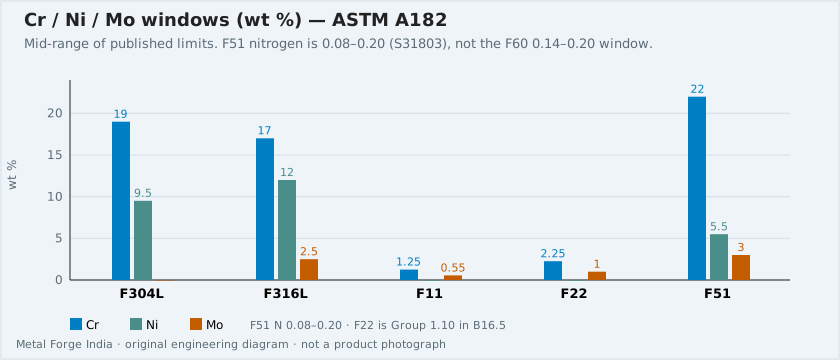
ASTM A182 grades — chemistry (weight %, typical published limits)
Values below are the commonly published maximums or ranges used on mill certificates for the grades buyers ask us about most. Always confirm against the current ASTM A182/A182M edition and the actual heat MTC. Where a cell shows a single number it is a maximum unless noted as a range.
| Grade | UNS (typical) | C | Cr | Ni | Mo | Others (notable) |
|---|---|---|---|---|---|---|
| F304 | S30400 | 0.080 max | 18.0–20.0 | 8.0–11.0 | — | Mn 2.00 max |
| F304L | S30403 | 0.030 max | 18.0–20.0 | 8.0–13.0 | — | Low-C weldable 304 |
| F316 | S31600 | 0.080 max | 16.0–18.0 | 10.0–14.0 | 2.00–3.00 | Mo for pitting resistance |
| F316L | S31603 | 0.030 max | 16.0–18.0 | 10.0–15.0 | 2.00–3.00 | Low-C weldable 316 |
| F11 Class 2 | K11572 | 0.10–0.20 | 1.00–1.50 | — | 0.44–0.65 | 1½Cr–½Mo low alloy |
| F22 Class 3 | K21590 | 0.05–0.15 | 2.00–2.50 | — | 0.87–1.13 | 2¼Cr–1Mo low alloy |
| F51 | S31803 | 0.030 max | 21.0–23.0 | 4.5–6.5 | 2.5–3.5 | N 0.08–0.20; duplex |
Indicative published limits for RFQ screening. Not a substitute for the ASTM standard or the heat certificate. Dual-cert F51/F60 heats exist — specify which chemistry window you need.
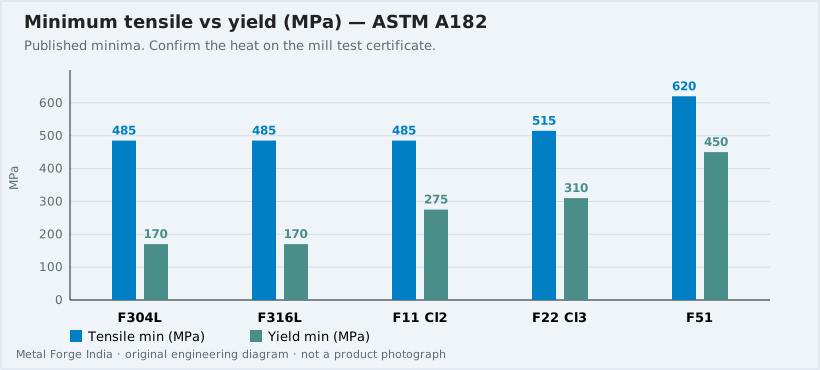
Mechanical properties (minimums commonly quoted)
| Grade | Tensile min, ksi (MPa) | Yield min, ksi (MPa) | Elongation min % | Heat treatment (typical) |
|---|---|---|---|---|
| F304 / F316 | 75 (515) | 30 (205) | 30 | Solution annealed |
| F304L / F316L | 70 (485) | 25 (170) | 30 | Solution annealed |
| F11 Class 2 | 70 (485) | 40 (275) | 20 | Normalize + temper |
| F22 Class 3 | 75 (515) | 45 (310) | 20 | Normalize + temper |
| F51 | 90 (620) | 65 (450) | 25 | Solution anneal (duplex) |
Minima vary by class (especially F11/F22). Hardness and impact (Charpy) are project-specific — they are not implied by ordering “A182” alone.
A182 material equivalents (ASTM / UNS / EN — approximate)
Equivalence is for screening, not a licence to substitute. EN 1.4404 is not automatically F316L until chemistry, heat treatment and product form are checked. Sour-service and projects often lock the exact designation in the piping class.
| ASTM A182 | UNS | EN / DIN (approx.) | Typical use |
|---|---|---|---|
| F304 / F304L | S30400 / S30403 | 1.4301 / 1.4307 | General stainless, food, water, low chloride |
| F316 / F316L | S31600 / S31603 | 1.4401 / 1.4404 | Better pitting resistance than 304; process + marine |
| F11 | K11572 | 13CrMo4-5 family | High-temp steam, refinery low-alloy |
| F22 | K21590 | 10CrMo9-10 family | Higher-temp / hydrogen service vs F11 (as specified) |
| F51 | S31803 | 1.4462 | Duplex; chlorides + higher strength |
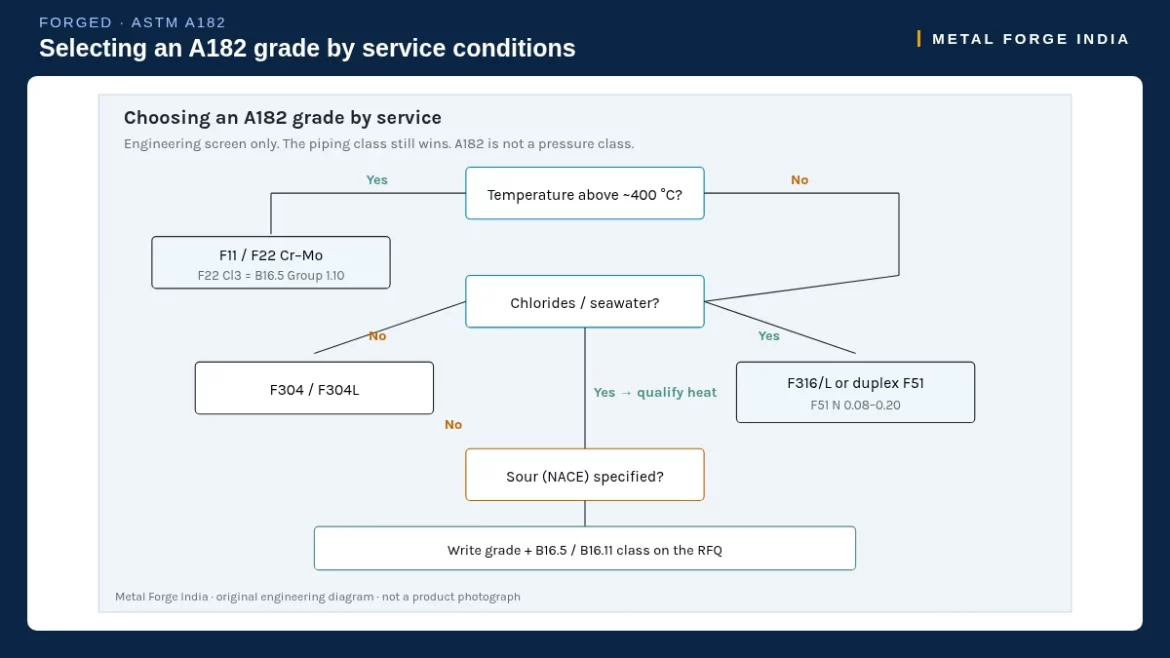
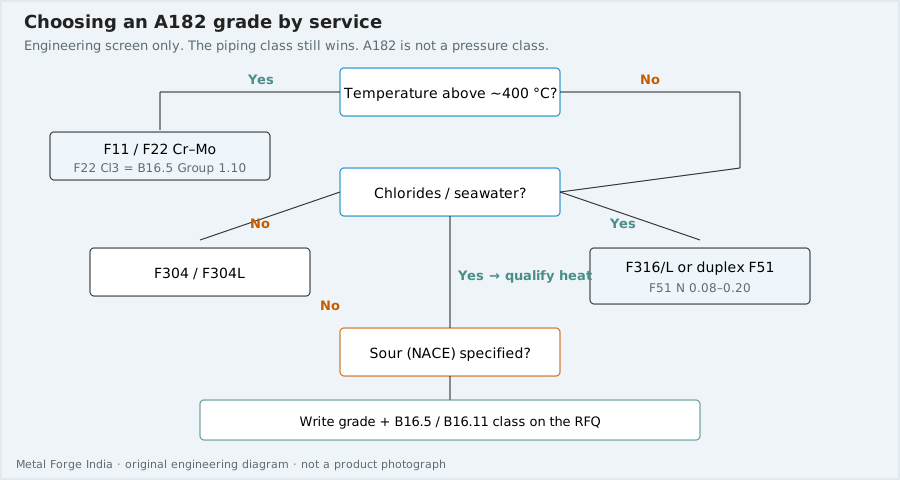
How to select an A182 grade by service
Temperature
Low-alloy F11 and F22 are the usual forged grades when the piping class is Cr-Mo for elevated-temperature steam or process. Stainless F304/F316 remain common for moderate process temperatures; creep and oxidation limits still come from the piping code and the owner’s material standard, not from a blog table. If the datasheet already names P11/P22 pipe, the matching forge grade is typically F11/F22 — not F316 “because it is stainless.”
Corrosion and chlorides
F304/F304L is the default austenitic for clean services. Move to F316/F316L when molybdenum is required for pitting. Duplex F51 is a step-change in chloride stress-corrosion resistance and strength versus 316L, at the cost of fabrication controls (heat input, ferrite, no 475 °C embrittlement on the weld). We do not treat NACE MR0175 / MR0103 as a default on every A182 item — if sour service applies, state it on the RFQ so the heat and hardness can be qualified.
Welding
L-grades (F304L, F316L) exist so the heat-affected zone stays below the carbon level that promotes knife-line attack after welding. For socket-weld B16.11 fittings the weld volume is small, but the same grade logic as the connecting pipe should still be used. Do not mix F304 fittings onto F316L pipe without a written exception.
Sour service
Hardness, nickel equivalent and heat treatment matter more than the grade name. If the ITB calls NACE, we quote only against that specification. This page does not claim that every F316 flange we ship is NACE-compliant.
Testing, inspection and MTC (EN 10204 3.1 / 3.2)
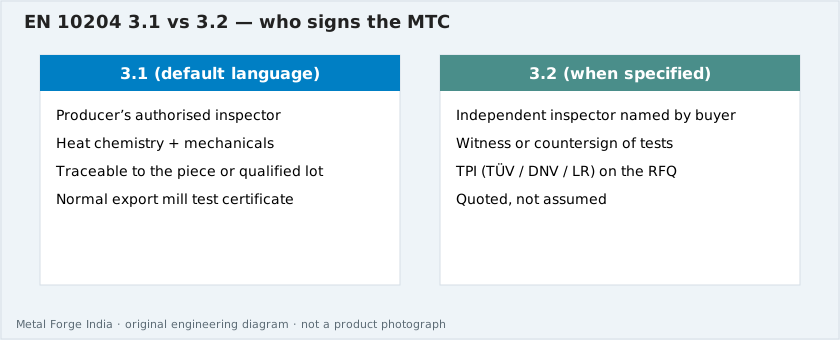
A usable A182 package is the forging plus a certificate that traces heat chemistry and mechanical tests to the piece (or to a qualified lot). EN 10204 3.1 is the normal mill document: the producer’s authorised inspector validates the tests. EN 10204 3.2 adds a purchaser-designated independent inspector. We supply 3.1 as standard documentation language on export lots; 3.2 is quoted when the client names the TPI.
- Chemical analysis per heat (and product analysis if the spec requires it)
- Tensile test after the required heat treatment
- Solution-anneal records for stainless; normalize + temper for F11/F22
- PMI on stainless/duplex when the client asks
- IGC (ASTM A262) for stainless when the piping class requires it
- Hydrotest of the assembly is a spool/system test — not an A182 coupon test
is the quality-system certificate we claim on the company. and apply to the equipment/module the client specifies — they are not a substitute for the A182 MTC. Certificate numbers and expiry are on the PDF issued with the order, not in this article.
Flanges vs forged fittings under A182
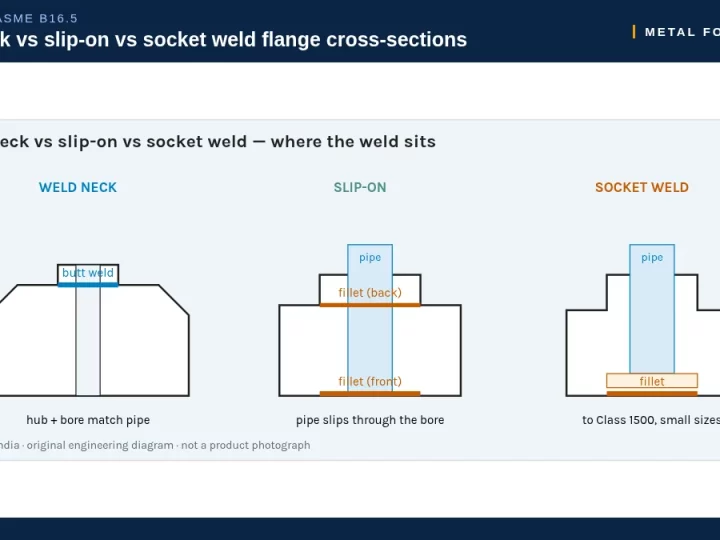
- Weld neck, slip-on, socket weld, threaded, blind, lap joint
- Class from B16.5 material group × temperature
- Facing RF / FF / RTJ as specified
- Elbows, tees, couplings, unions — socket-weld or threaded
- Class 2000 / 3000 / 6000 (9000 if specified)
- Not a buttweld B16.9 fitting
- Wrought buttweld elbows, tees, reducers, caps
- Stainless WP grades, not A182 F-grades
- See the buttweld B16.9 guide
Related reading on a single grade: ASTM A182 F304 stainless steel flanges. The older 2025 overview URL now points here.
Pressure ratings — why A182 is not a class
Procurement still writes “A182 F316 Class 150” as if the grade owned the pressure. It does not. ASME B16.5 assigns a material group (for example Group 2.1 for 304, Group 2.2 for 316 — confirm in the current edition) and then a pressure-temperature chart for each class. At elevated temperature the allowable pressure falls; at ambient a Class 150 F316 flange is not “the same as” a Class 300 F304 flange. Socket-weld and weld-neck flanges of the same grade and class share the chart and do not share the joint.
Forged fittings (B16.11) use a different class language: 2000, 3000, 6000 (and 9000). Those numbers are not B16.5 classes. An RFQ that says “3000 lbs A182 F316 flange” is ambiguous — it might be a B16.11 fitting class copied onto a flange line. We will ask which standard applies rather than guess.
F51 duplex versus 316L — when the upgrade is real
Duplex F51 is not “better 316.” It is a two-phase alloy with higher yield and better chloride stress-corrosion resistance, and it punishes sloppy welding. If the piping class is 316L because of a chloride cooling-water spec, F51 may be justified. If the class is 316L because that is what the warehouse holds, changing the forge grade without changing the pipe is a mismatch. Heat-input, interpass temperature and ferrite measurement belong in the WPS when F51 is welded; they do not belong in a flange-only PO unless the flange is welded (WN) into F51 pipe.
Some mills dual-certify F51/F60 (S31803/S32205). F60 has a tighter nitrogen/chromium window. If the owner spec says S32205, write F60 or dual-cert on the RFQ. Do not assume F51 satisfies F60.
Worked RFQ examples (what we can quote vs what we send back)
- Quotable: “8″ 300# WN RF ASTM A182 F316L, 12 pcs, EN 10204 3.1, CIF Jebel Ali.”
- Quotable: “B16.11 90° elbow, 1″ 3000 SW, A182 F304L, 200 pcs, 3.1, FOB Nhava Sheva.”
- Not yet quotable: “A182 fittings, best price, urgent.” — missing form, size, class, grade.
- Wrong standard: “A182 WP316 buttweld elbow” — that is A403, not A182. We will restate the spec rather than mint an illegal item.
Metal Forge India will not invent a mill-stock list, a guaranteed week-count, or a certificate number on this page. Those answers are order-specific and belong in the reply to the RFQ.
How this page is used with product URLs
Use this article to choose a grade and to write the material line of a PO. Use forged fittings or flanges to choose the shape. Use the weld-neck vs slip-on vs socket-weld comparison when the isometric is still undecided. Nickel alloys that are not A182 (Inconel 625, Monel 400, Hastelloy C276) have their own product URLs — do not force them into an F-grade table.
What to put on an ASTM A182 RFQ
- Grade and any dual grade (F316/F316L, F51/F60)
- Product: flange type or B16.11 fitting type
- NPS / DN and pressure class
- Facing or thread / socket detail
- Quantity and whether a blank or a matching pair is required
- MTC 3.1 or 3.2, TPI name if 3.2
- NACE / IGC / IBR / module only if the datasheet requires them
- Destination port and any packing constraint
Request A182 flanges or forged fittings
Send size, class, grade and quantity. Factory: Mehsana, Gujarat. HQ: Mumbai.
Inspector checklist (what we look at on an MTC)
- Does the heat chemistry sit inside the A182 table for the named grade — including L-grade carbon if L was ordered?
- Is the heat-treatment condition the one A182 requires for that grade (solution anneal vs normalize + temper)?
- Do tensile and yield meet the class (F11/F22 classes especially)?
- Is the product form a forging/flange/fitting, not a plate cert reused without a qualifying statement?
- Does the certificate number on the piece match the MTC heat?
- If NACE or IGC was ordered, is the extra test on the same document or an annex?
Glossary
- SA-182 — ASME Boiler and Pressure Vessel Code adoption of ASTM A182; buyers often write ASTM and ASME interchangeably on POs.
- F-grade — A182 forging grade letter, not a B16.5 class.
- Solution anneal — stainless heat treatment that puts carbides back into solution; required for F304/F316 families.
- PREN — pitting resistance equivalent number; used on duplex/super-austenitic discussions, not a substitute for the grade name.
- PMI — positive material identification, usually XRF, used to stop mix-ups between 304 and 316 in the shop.
Offices in exist for coordination. They do not change the mill certificate: the heat is still Indian production from Mehsana unless a PO says otherwise (this site does not claim foreign mill stock).
FAQ — ASTM A182 grades
What is ASTM A182?
ASTM A182 / ASME SA-182 is the standard specification for forged or rolled alloy and stainless steel pipe flanges, forged fittings, valves and parts for high-temperature service. It defines chemistry, heat treatment and mechanical properties for named grades such as F304, F316, F11, F22 and F51.
What is the difference between ASTM A182 F304 and F304L?
F304L limits carbon to 0.030% max (F304 is 0.080% max). The lower carbon in F304L reduces the risk of carbide precipitation during welding. Tensile minima are slightly lower for the L grades. Choose F304L when as-welded corrosion resistance in the heat-affected zone matters.
Is ASTM A182 used for flanges or only for fittings?
Both. A182 covers forged flanges, forged fittings (typically ASME B16.11 socket-weld and threaded) and similar parts. Weld-neck and other flanges to ASME B16.5 in stainless or alloy steel are commonly ordered as A182 F304/F316/F11/F22. Buttweld fittings in stainless are a different standard (ASTM A403), not A182.
What does F51 mean in ASTM A182?
F51 is a duplex stainless grade, roughly UNS S31803 (sometimes dual-certified S32205 / F60 depending on the mill). It is used where chloride stress-corrosion and higher strength than 316L are required. Confirm PREN, heat treatment and ferrite content on the MTC — do not assume every duplex heat is F51.
Does A182 include pressure ratings?
No. A182 sets material properties. Pressure-temperature ratings for a flange come from ASME B16.5 or B16.47 for the selected material group and class. A fitting’s pressure class comes from ASME B16.11. Always pair the A182 grade with the dimensional standard on the RFQ.
What MTC should we request with A182 material?
Ask for EN 10204 3.1 as the default mill test certificate, showing heat chemistry and mechanical results. EN 10204 3.2 (independent inspection) is available when a project specification requires it — it is not assumed on every order. PMI, IGC (for stainless) and NACE testing are added only when specified.
A182 vs A105 — which do I need?
ASTM A105 is carbon steel forgings for piping. ASTM A182 is alloy and stainless. Use A105 for standard carbon-steel flanges and forged fittings. Use A182 when the datasheet calls for stainless (F304/F316), low-alloy (F11/F22) or duplex (F51). Do not substitute one for the other without engineering review.
What information does Metal Forge India need on an A182 RFQ?
Grade (and dual grade if required), product form (flange type or B16.11 fitting), size, class, facing or end, quantity, any NACE / IGC / 3.2 / IBR requirement, and destination. We manufacture and export forged fittings and flanges from Mehsana, Gujarat, with HQ in Mumbai.
Key takeaways
- A182 is the forging material spec; B16.5 / B16.11 set dimensions and class.
- F304 vs F304L (and F316 vs F316L) is a carbon / weldability choice.
- F11/F22 are Cr-Mo; F51 is duplex — not drop-in stainless substitutes.
- EN 10204 3.1 is the normal MTC; 3.2 and NACE only when specified.
- Stainless buttweld fittings are A403, not A182.
Related specifications
Metal Forge India manufactures and exports A182-grade forged product from India. We do not quote mill stock positions or lead times on this page; those belong on the RFQ.
Pressure ratings that actually sit next to A182
Buyers search “A182 pressure ratings” because the flange class is what the piping class cares about. Pair the forging grade with ASME B16.5 material groups (for example Group 2.1 for F304, Group 2.2 for F316, Group 1.9 for F11 Class 2 and Group 1.10 for F22 Class 3). The table is indicative at 38 °C for raised-face flanges.
| Class | Material group | Typical grade | Working pressure at 38 °C (bar) | Working pressure at 38 °C (psi) |
|---|---|---|---|---|
| 150 | 1.1 | A105 | 19.6 | 285 |
| 150 | 2.1 | F304 | 19.0 | 275 |
| 300 | 1.1 | A105 | 51.1 | 740 |
| 300 | 2.1 | F304 | 49.6 | 720 |
| 600 | 1.1 | A105 | 102.1 | 1480 |
| 600 | 2.1 | F304 | 99.3 | 1440 |
ASME B16.5 Table 2-1.1 Group 1.1 at 38 °C, raised face. A182 itself is not a pressure class. The edition named on the purchase order governs.
Grades that show up on RFQs besides F304/F316/F11/F22/F51
F321 and F347 are titanium- or niobium-stabilised austenitics for polythionic / weld-decay service. F5 and F9 are 5Cr and 9Cr. F91 is 9Cr-1Mo-V. Super duplex F53 (S32750) and F55 (S32760) are not drop-in F51. Chemistry rows for those grades are not published here without a quoted heat.
For IBR steam, IBR-approved F11/F22 flanges are the usual pairing, not a random F304 heat. Forged A182 olets follow the same grade logic as B16.11 fittings. Weld-neck hubs in F316L are ordered as A182 F316L weld neck flanges.