
Buttweld fittings · ASME B16.9 · 2026
Metal Forge India manufactures and exports buttweld fittings from India (factory Mehsana, Gujarat; HQ Mumbai; since 1979). Commercial hub: buttweld fittings. Beginner definition (kept as a separate intent): what is a butt weld pipe fitting and buttweld fittings types & uses.
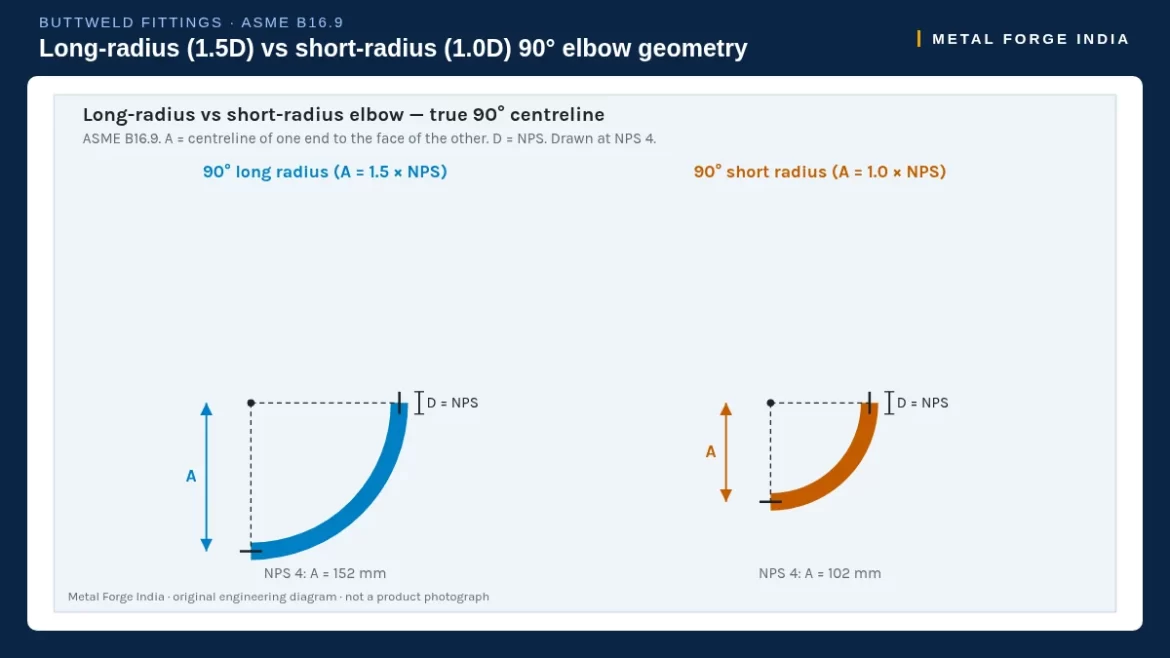
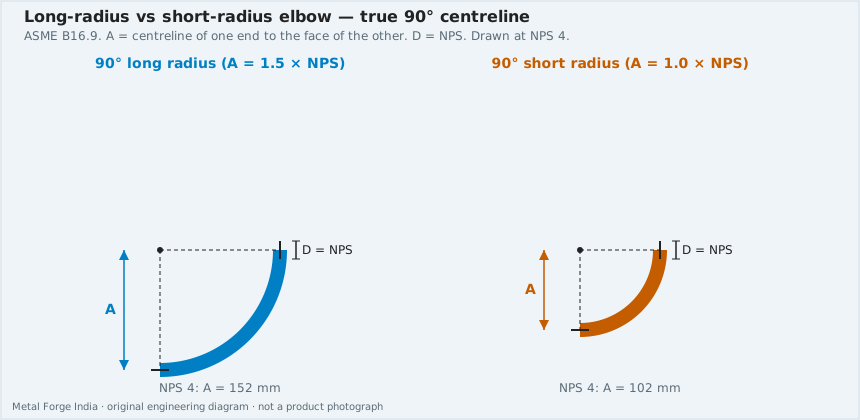
ASME B16.9 dimensions wrought buttweld elbows, tees, reducers, caps and stub ends. Letter A is centre-to-end on a 90° elbow: 1.5 × NPS long radius, 1.0 × NPS short radius; D = NPS. Duplex WP fittings are ASTM A815, not A403. Name NPS, schedule and grade on the RFQ.
Metal Forge India has manufactured flanges, fittings and pipe spools since 1979. Head office: Mumbai. Factory: Mehsana, Gujarat.
Download B16.9 spec chart (PDF)
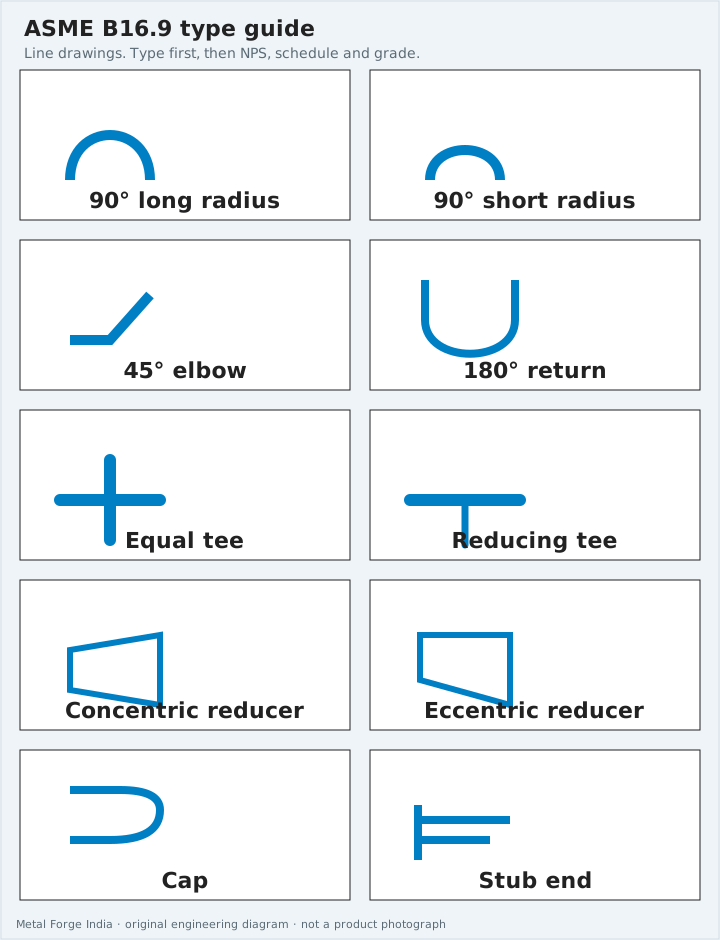
Types of buttweld fittings
- 90° LR (default), 90° SR, 45°, 180° returns
- R = 1.5D or 1.0D
- See 90° types & dimensions guide
- Equal tee, reducing tee
- Cross where four runs meet
- Olets are a different product
- Concentric / eccentric reducers
- Caps to close a run
- Stub ends with lap-joint flanges
- 45° elbow
- 180° elbow / return
- Eccentric reducer
- Pipe cap
- Stub end (pairs with a lap-joint flange)
- 90° elbow types & dimensions guide
Long radius vs short radius elbow
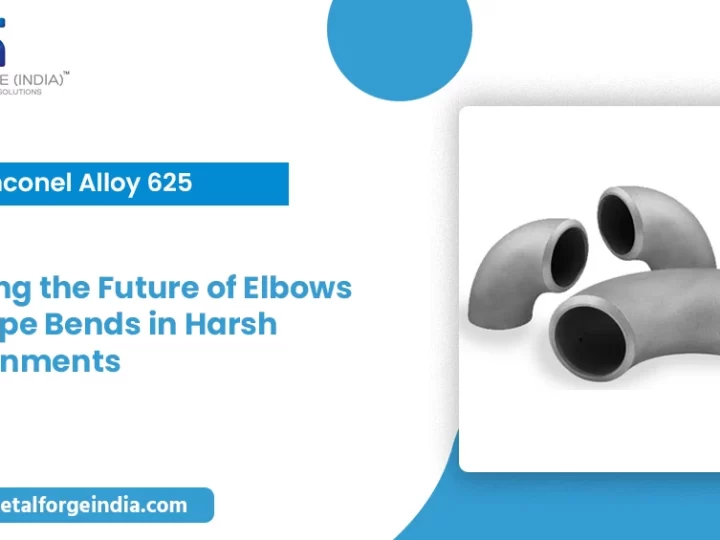
Centre-to-face of a 90° elbow is the radius. LR (1.5D) is the B16.9 default because the slightly longer path reduces pressure drop and moment compared with SR (1.0D). SR exists so a rack can turn in a tighter envelope. Do not convert an LR isometric to SR without restressing the line. 45° elbows in B16.9 are LR geometry.
| NPS | 90° LR A ≈ 1.5D (mm) | 90° SR A ≈ 1.0D (mm) | 45° LR B (mm) |
|---|---|---|---|
| 2 | 76 | 51 | 35 |
| 3 | 114 | 76 | 51 |
| 4 | 152 | 102 | 64 |
| 6 | 229 | 152 | 95 |
| 8 | 305 | 203 | 127 |
| 12 | 457 | 305 | 190 |
Indicative centre-to-end values commonly published for B16.9 carbon/stainless. Small NPS (½–1½) are not exactly 1.5×NPS. Confirm against the current ASME B16.9 edition and the fitting mill drawing.
ASME B16.9 dimension notes (tees, reducers, caps)
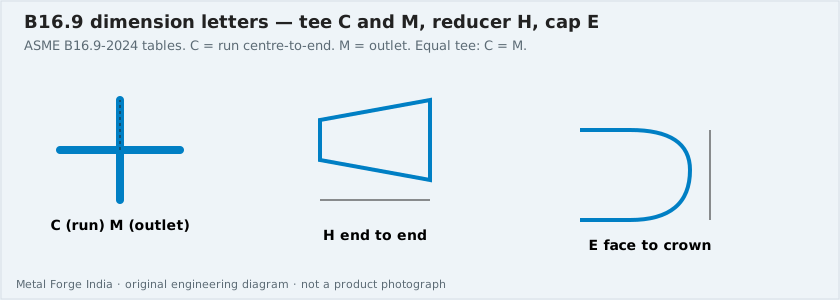
Tees: centre-to-end C (run) and M (outlet) are tabulated in B16.9; a reducing tee is not a cut-down equal tee. Reducers: end-to-end length grows with the larger NPS. Caps: length is short; the bevel matches the pipe. Stub ends: Type A/B/C (MSS SP-43 vs B16.9) must match the lap-joint flange facing — wrong type is a common RFQ error.
Wall thickness: order the fitting to the pipe schedule (STD, XS, XXS, or a millimetre wall). B16.9 allows the fitting interior to differ slightly from the pipe ID; if you need a controlled bore (for pigging or erosion), say so.
Material grades
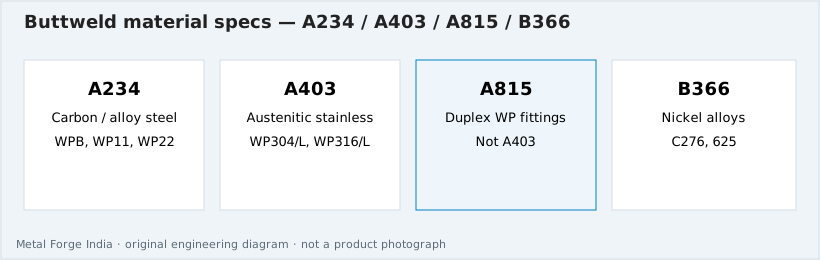
| Family | Typical spec | Example grades | Notes |
|---|---|---|---|
| Carbon steel | ASTM A234 | WPB, WPC | Default CS buttweld |
| Low alloy | ASTM A234 | WP11, WP22 | Match P11/P22 pipe |
| Stainless | ASTM A403 | WP304/304L, WP316/316L | Not A182 (that is forgings) |
| Duplex | A815 | UNS S31803 / S32205 as specified | WPS heat-input limits |
| Nickel alloys | ASTM B366 and related | Inconel 625, Monel 400, C276 | See nickel product URLs |
Grade must match the pipe specification, not a generic “stainless.” Nickel commercial pages: Inconel 625 fittings, Monel 400 buttweld, Hastelloy C276 fittings.
Related nickel landings: Inconel 625 pipe fittings, Monel 400 buttweld fittings, Hastelloy C276 pipe fittings.
Buttweld fittings vs bends vs forged fittings
- B16.9 elbow — a fitting with a sharp (1D or 1.5D) turn.
- Pipe bend — pipe bent to 3D/5D/10D; see pipe bends and 3D vs 5D.
- B16.11 forged — socket-weld/threaded small-bore; forged fittings and forged vs buttweld.
Tees, reducing tees and why olets are not a tee
An equal tee has the same NPS on the run and the outlet. A reducing tee has a smaller outlet; the centre-to-end dimensions in B16.9 are not those of the equal tee. On small branches, many isometrics use a Weldolet or Sockolet instead of a reducing tee — that is MSS SP-97, not B16.9. Do not convert a tee BOM to olets (or the reverse) without restressing reinforcement. Ranking olet comparison URLs stay put: Weldolet vs Sockolet vs Threadolet.
Reducers on pump suctions and piggable lines
Eccentric reducers with the flat on the bottom keep a pump suction flooded and avoid a vapour pocket. Flat-on-top is a different isometric. Concentric reducers on a horizontal pump suction are a common construction error. Piggable lines often forbid abrupt SR elbows and some reducer geometries — if the line is piggable, write it on the RFQ so we do not quote a short-radius 90° into a launcher.
Schedules, XS/XXS and specified wall
STD (often SCH 40 up to NPS 10, then SCH 30/STD divergence — use a schedule table, do not memorise) is the usual carbon default. XS and XXS are still ordered on erosion or mechanical-protection lines. Stainless often uses SCH 10S / 40S / 80S. If the pipe is a millimetre wall (for example 10.31 mm), put that millimetre on the fitting RFQ rather than a nearest schedule. Mismatch at the bevel is a site grind.
Nickel and duplex buttweld — same B16.9, different WPS
Inconel 625, Monel 400 and Hastelloy C276 buttweld fittings follow B16.9 dimensions when ordered as wrought fittings, with material specs such as ASTM B366. Duplex needs heat-input control. We already publish commercial URLs for Inconel 625, Monel 400 and Hastelloy C276. This guide does not replace those pages and does not create Inconel 600 or 904L product URLs.
For carbon vs stainless vs alloy selection in general industrial language, see buttweld fittings in various alloys — that article remains educational; this page is the dimensional B16.9 companion.
Ends, bevels and welding
Standard ends are bevelled for buttwelding (typically 37.5° ± per the WPS / ASME B16.25, as specified). Stainless and nickel alloys may need purge. IBR marking applies only when the item is in IBR scope — see the IBR approved pipe fittings guide; we do not stamp IBR on every elbow by default.
Request buttweld fittings
Send type, NPS, schedule, grade and quantity. Factory: Mehsana. HQ: Mumbai.
Common mistakes on buttweld POs
- Ordering A182 F316 buttweld elbows — that grade family is for forgings; use A403 WP316/WP316L.
- Swapping LR and SR to save space after the stress analysis used LR.
- Putting a concentric reducer on a horizontal pump suction.
- Omitting schedule, then expecting STD and 10S to mate without a bore mismatch.
- Calling a 3D bend an elbow (or the reverse). Bends live on /pipe-bends/.
- Using the beginner guide as the only internal link. Keep what is a butt weld pipe fitting for definition queries; use this page for B16.9.
On export lots, bevel protection and end caps matter as much as chemistry. A damaged bevel is a site weld repair. Packing notes sit on the export hub.
Worked examples
- Quotable: “8″ SCH 40 90° LR elbow, ASTM A234 WPB, bevelled ends, 40 pcs, 3.1.”
- Quotable: “6″ × 4″ eccentric reducer, SCH 40S, A403 WP316L, FOB Nhava Sheva, 12 pcs.”
- We will restate: “A182 F316 buttweld tee” → A403 WP316 unless you truly want a forged B16.11 tee.
- We will query: “SR 90° on a piggable 12″ line” — may be forbidden by the owner spec.
Dimensions we will not paste
Full B16.9 centre-to-end tables for every NPS, including ½ through 48, are copyrighted ASME content. The sample rows in this article are for envelope checks on common sizes. For a full mill drawing we issue a fitting-specific drawing with the order, not a scraped standard. If your 3D catalogue needs every NPS, use a licensed ASME source — do not scrape this page as a CAD library.
Glossary
- LR / SR — long radius (1.5D) / short radius (1.0D) for 90° elbows.
- WP — wrought product grade prefix in A403 (WP304, WP316L…).
- WPB — standard carbon buttweld grade in A234.
- Bevel — prepared weld end, typically to B16.25 / WPS.
- Stub end — lap-joint companion fitting; type A/B/C must match the flange.
- Return — 180° elbow.
1.5D as a bend (not an elbow) is a different product: 1.5D vs 3D pipe bend remains on its ranking URL. Do not order a B16.9 SR elbow when the isometric says 1.5D bend.
FAQ — buttweld fittings and B16.9
What are buttweld fittings?
Buttweld (butt-weld) fittings are wrought pipe fittings with bevelled ends that are welded to pipe with a full-penetration butt weld. ASME B16.9 covers factory-made wrought fittings — elbows, tees, reducers, caps, lap-joint stub ends — for NPS ½–48 (and larger as specified).
What is the difference between long radius and short radius elbows?
A long-radius (LR) 90° elbow has centre-to-face ≈ 1.5 × NPS. A short-radius (SR) 90° elbow has centre-to-face ≈ 1.0 × NPS. LR is the default for flow and stress. SR is used where space is tight and the piping class allows it. 45° elbows are LR in normal B16.9 tables.
Buttweld vs forged (socket-weld / threaded) fittings?
Buttweld fittings are B16.9, welded into the pipe run, typical from NPS 2 upward (and smaller when specified). Forged fittings are B16.11, socket-weld or threaded, typical on small-bore. They are different products — see also forged vs buttweld on this site.
Which material grades are used?
Carbon (e.g. ASTM A234 WPB), stainless (A403 WP304/WP316 and L grades), alloy (A234 WP11/WP22), duplex and nickel alloys (for example Inconel 625, Monel 400, Hastelloy C276) as the line class names. Stainless buttweld is A403, not A182.
Do B16.9 dimensions include wall thickness?
B16.9 gives centre-to-end and some end-to-end lengths. Wall thickness of the fitting generally matches the connecting pipe schedule, with permitted local variation in the standard. Always state NPS and schedule (or specified thickness) on the RFQ.
What is a concentric vs eccentric reducer?
Concentric reducers keep a common centreline — use on vertical lines and where air/vapour should not pocket. Eccentric reducers have an offset face (flat-on-bottom or flat-on-top) to keep a pump suction flooded or to hold a constant BOP/TOP. They are not interchangeable on a pump suction without a look at the isometrics.
Are 180° returns and 3D bends the same as elbows?
A 180° B16.9 return is an elbow geometry. A 3D/5D/10D pipe bend is induction- or cold-bent pipe, covered as a bend product, not as a B16.9 fitting. See pipe bends on this site.
What belongs on a buttweld RFQ?
Type (90° LR, tee, concentric reducer…), NPS, schedule, grade, ends (bevel to which spec), quantity, and any IBR / 3.2 / NACE requirement.
Key takeaways
- B16.9 = wrought buttweld shapes and centre-to-end dimensions.
- LR 90° ≈ 1.5D; SR 90° ≈ 1.0D; do not swap them on a stressed line.
- Stainless buttweld is A403, not A182.
- Reducers: concentric vs eccentric is a layout decision, especially at pumps.
- Bends (3D/5D) are not B16.9 elbows.
Related specifications
Tee, reducer and cap dimensions (ASME B16.9, mm)
Letters: tee C (run centre-to-end) and M (outlet); reducer overall length H; cap length E. Equal tees have C = M. Values are published mill-chart millimetres.
| NPS | Equal tee C/M | Reducer H (typ. concentric) | Cap E |
|---|---|---|---|
| 2 | 64 | 76 | 38 |
| 3 | 86 | 89 | 51 |
| 4 | 105 | 102 | 64 |
| 6 | 143 | 140 | 89 |
| 8 | 178 | 152 | 102 |
| 10 | 216 | 178 | 127 |
| 12 | 254 | 203 | 152 |
ASME B16.9 millimetres. Reducing-tee M follows the outlet NPS, not the run. H is governed by the large end.
Wall thickness is not a B16.9 column
B16.9 gives centre-to-end and overall lengths. Wall is the matching pipe schedule (or a minimum as specified). Do not RFQ “SCH 40 elbow” without NPS and grade.
Stub ends and lap-joint flanges
A stub end is a B16.9 fitting that mates a lap-joint flange. Short vs long pattern is a piping-class choice. Mating weld neck flanges are the usual alternative when the class wants a WN hub instead of a lap joint.
Prefabrication: fittings are often pre-welded into spools so the site only closes field joints.